
Push-Up Test Calculator
Research shows push-up tests have moderate reliability due to subjective form evaluation (79.4% evaluator agreement on “perfect” technique). For best results: film yourself from the side, count only strict reps meeting all criteria, and track progress trends over 4-6 weeks rather than relying on single-test scores.
Check off each element you can perform correctly. Common faults include incomplete arm extension (10.2% of denied reps), inadequate arm flexion (7%), and body not straight/rigid (6.3%).
Starting Position
Lowering Phase
Pressing Phase
Log your push-up tests over time to see progress. Aim to retest every 4-6 weeks for reliable improvement tracking.
Get a customized 8-week push-up training program based on your current level and goals.
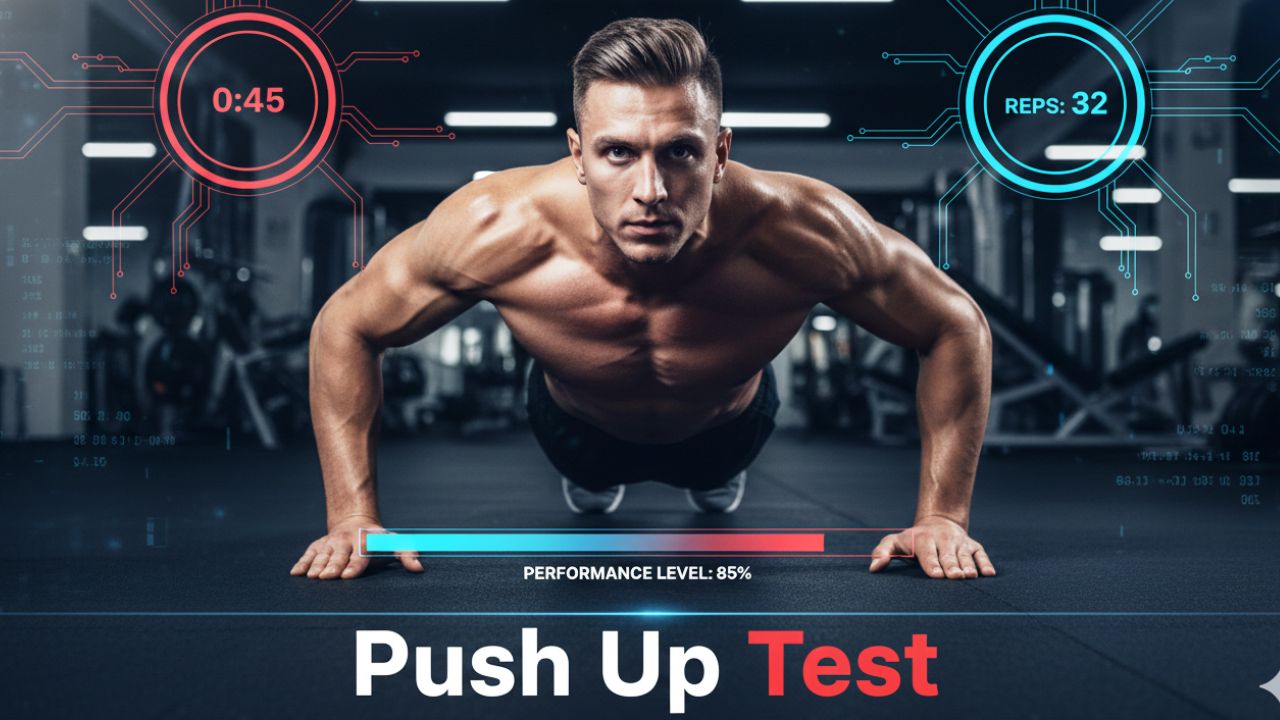
What is the Push-Up Test?
The push-up test is a simple, equipment-free assessment of upper body muscular strength and endurance. It measures how many proper push-ups you can perform, either in a set time period or until exhaustion. This test is widely used by military organizations, fitness professionals, and health organizations like the American College of Sports Medicine (ACSM) to evaluate physical fitness.
Push-ups primarily work the pectoralis major (chest), anterior deltoids (shoulders), and triceps brachii (back of arms), while also engaging your core muscles for stabilization. The test provides insights into your functional upper body strength and muscular endurance capacity.
How to Perform a Proper Push-Up
Standard Push-Up (Toes) Protocol
- Starting Position: Place hands shoulder-width apart on the floor. Extend legs back with feet together, supporting weight on hands and toes. Body should form a straight line from head to heels.
- Lowering Phase: Lower body by bending elbows to approximately 45° angle. Descend until chest is 3 inches from floor (or until a fist placed under chest is touched).
- Pressing Phase: Push back up to starting position with full arm extension. Maintain rigid body alignment throughout.
- Repetition: One complete push-up = chest down to 3″ + return to full arm extension.
Modified Push-Up (Knees) Protocol
For beginners or fitness assessments requiring modified form:
- Same hand placement as standard push-ups
- Rest knees on floor instead of toes
- Maintain straight line from head to knees
- Follow same lowering and pressing mechanics
Common Push-Up Mistakes and Fixes
Research by Kellner et al. (2023) identified the most common technical flaws in push-up testing:
- Incomplete Arm Extension (10.2%): Not fully locking out elbows at top
- Inadequate Arm Flexion (7%): Not lowering chest to proper depth
- Body Not Straight/Rigid (6.3%): Hip sag or pike position
How to Fix Common Errors
Problem: Sagging Hips
Fix: Engage your core by pulling belly button toward spine. Squeeze glutes throughout movement. If needed, practice plank holds to build core strength.
Problem: Incomplete Range of Motion
Fix: Place a foam roller or tennis ball under your chest. Lower until you touch it, then press back to full lockout. Film yourself from the side to verify depth.
Problem: Flaring Elbows (90° angle)
Fix: Keep elbows at 45° angle from body. Think “arrow” not “T” shape. This protects shoulders and improves strength transfer.
Push-Up Test Reliability – What Research Shows
Unlike many fitness tests, push-up assessments have documented reliability limitations that users should understand for accurate self-evaluation:
Scientific Findings on Test Objectivity
A 2023 study by Kellner et al. published in the Journal of Physical Education and Sport examined push-up test objectivity. Ten highly experienced physical education instructors evaluated 50 videorecorded performances in two separate trials. Key findings:
- Inter-rater Agreement: Only 79.4% consensus on “perfect” technique execution between evaluators
- Intra-rater Reliability: Individual evaluator consistency ranged from r=0.57 to r=0.92 (moderate to good reliability)
- Gender Bias: Male evaluators demonstrated more leniency toward female participants’ technique flaws
- Counting Errors: Miscounts occurred in 88% of “perfect” technique cases, suggesting cognitive drift during evaluation
To maximize reliability: (1) Record yourself from side angle to verify depth and lockout, (2) Count only reps meeting all criteria (3″ chest depth, full arm extension, body rigid), (3) Use identical conditions for retesting (time of day, warm-up, rest status), (4) Track 4-6 week trends rather than single-test scores, (5) Consider having the same person evaluate all tests if not self-counting.
ACSM Push-Up Norms Explained
The American College of Sports Medicine (ACSM) provides age and gender-specific norms derived from extensive population studies. These standards represent push-up performance for healthy, non-athletic adults.
How Norms Are Categorized
- Excellent: Top 20% of population for age/gender
- Good: Above average (60-80th percentile)
- Average: Typical performance (40-60th percentile)
- Continue Working: Below average (20-40th percentile)
- Need to Improve: Bottom 20%, priority development area
Age Considerations: Push-up capacity naturally declines with age due to sarcopenia (muscle loss), reduced neural drive, and connective tissue changes. A 60-year-old performing 15 push-ups demonstrates equivalent relative fitness to a 25-year-old doing 35 push-ups.
Gender Differences: Women typically have 50-60% of male upper body strength due to hormonal and muscle mass differences. Modified push-ups (on knees) reduce load by approximately 49-53% compared to standard push-ups, making them more accessible for beginners and those building foundational strength.
Related Fitness Calculators
Optimize your complete fitness assessment with these complementary tools:
- Sets and Reps Calculator – Design your push-up training program
- Workout Intensity Calculator – Optimize training load
- Progressive Overload Calculator – Plan strength progression
- Tempo & TUT Calculator – Master time under tension
This push-up test calculator provides fitness assessments based on ACSM standards for informational and educational purposes only. Results should not replace professional fitness evaluations or medical advice. Always consult with a qualified healthcare provider or certified fitness professional before beginning any new exercise program, especially if you have pre-existing health conditions, injuries, or concerns about your physical capabilities.
References
- Hashim, Ahmad & Ariffin, Azli & Hashim, Talib & Yusof, Abu. (2018). Reliability and Validity of the 90º Push-Ups Test Protocol. International Journal of Scientific Research and Management. 6. 10.18535/ijsrm/v6i6.pe01.
- ADAMS, M. M., HATCH, S. A., WINSOR, E. G., & PARMELEE, C. (2022). Development of a Standard Push-up Scale for College-Aged Females. International Journal of Exercise Science, 15(4), 820. https://doi.org/10.70252/XIJI4089
- Kellner, Petr & Neubauer, Jiří & Polách, Michal. (2021). Objectivity of push-up tests and technique assessment – JPES. Journal of Physical Education and Sport. 21. 1629-1634. 10.7752/jpes.2021.04206.
