
Chest to Waist Ratio Calculator
Calculate your chest-to-waist ratio for physique assessment and fitness tracking
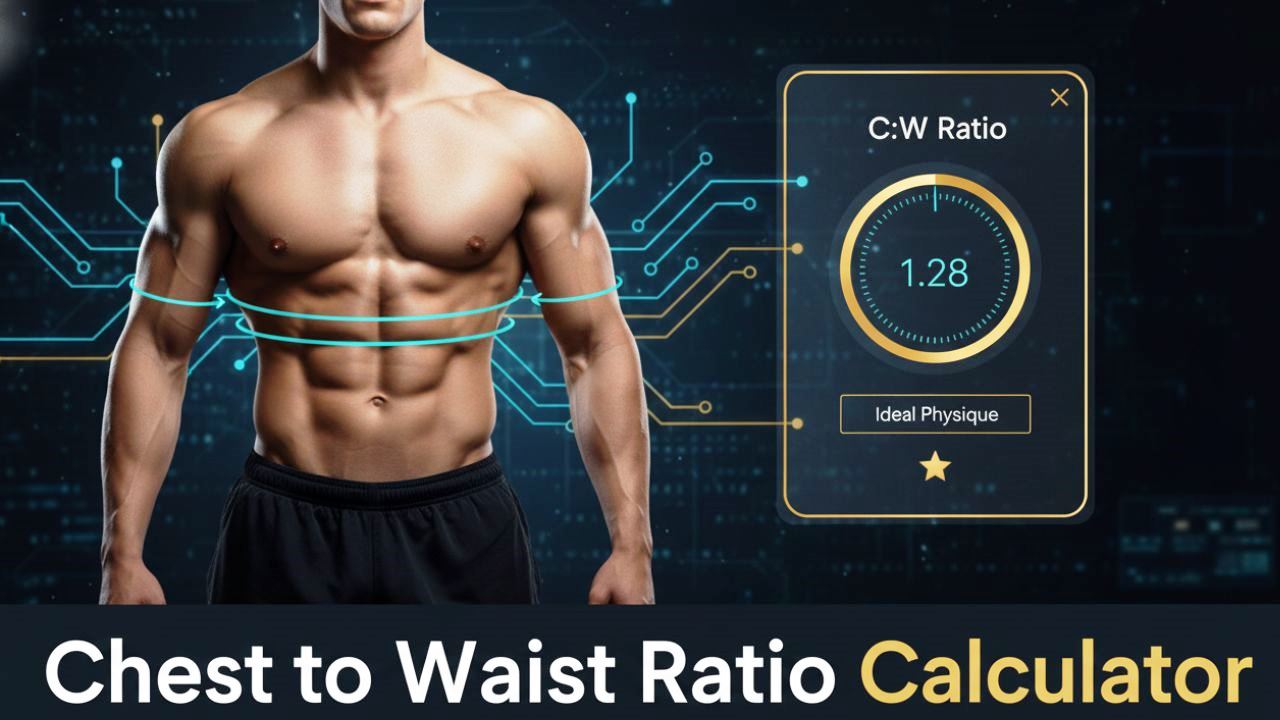
What is Chest-to-Waist Ratio?
Chest-to-Waist Ratio (CWR) is a body proportion measurement that compares your chest circumference to your waist circumference. It’s calculated by dividing chest measurement by waist measurement, producing a ratio that indicates upper body development and body composition.
CWR is an important indicator of physical fitness, aesthetic appeal, and overall health. A higher ratio indicates more chest muscle mass relative to waist size, suggesting lower body fat and better upper body development.
Unlike BMI which only considers height and weight, CWR provides insight into muscle development and fat distribution, making it particularly useful for fitness enthusiasts, bodybuilders, and anyone focused on physique improvement.
How to Calculate Chest-to-Waist Ratio
Waist: 32 inches (81 cm)
Calculation: 42 ÷ 32 = 1.31
Result: CWR 1.31 (Very Good)
Interpretation: Well-developed upper body with good waist control. Fit physique.
Waist: 36 inches (91 cm)
Calculation: 38 ÷ 36 = 1.06
Result: CWR 1.06 (Poor)
Interpretation: Underdeveloped chest or high body fat. Focus on chest training and fat loss.
CWR Categories & Standards
| CWR (Men) | CWR (Women) | Category | Description |
|---|---|---|---|
| ≥ 1.40 | ≥ 1.25 | Excellent | Athletic/bodybuilder physique |
| 1.30-1.39 | 1.15-1.24 | Very Good | Fit, well-developed upper body |
| 1.20-1.29 | 1.05-1.14 | Good | Average fitness level |
| 1.10-1.19 | 0.95-1.04 | Fair | Room for improvement |
| < 1.10 | < 0.95 | Poor | High body fat / underdeveloped chest |
Note: These standards are based on research on body aesthetics and fitness benchmarks. Individual goals may vary. Always warm up properly before training—use our Workout Warm-Up Calculator for optimal preparation.
How to Measure Correctly
Chest Circumference Measurement
Measurement Point: At nipple line (or widest point of chest for women), arms relaxed at sides.
Proper Technique: Stand upright with shoulders relaxed. Take a normal breath, exhale halfway, and measure. Don’t puff out your chest or arch your back. The tape should be parallel to the floor and snug but not compressing the skin.
Consistency: Measure at the same time of day (morning before eating is ideal). Take three measurements and use the average. Avoid measuring immediately after training when muscles are pumped.
Waist Circumference Measurement
Measurement Point: At belly button level (umbilicus), which is typically the narrowest part of your torso.
Proper Technique: Stand naturally with feet hip-width apart. Exhale normally and relax your abdomen. Don’t suck in your stomach or hold your breath. The tape should be horizontal and snug without compressing the skin.
Timing: Measure in the morning before eating for most consistent results. Track monthly for progress monitoring. Before measuring, always warm up properly—use our Workout Warm-Up Calculator to prepare your body.
Target CWR by Gender & Goal
| Gender | Health Goal | Aesthetic Goal | Athletic Goal |
|---|---|---|---|
| Men | 1.20-1.30 | 1.30-1.40 | 1.40+ |
| Women | 1.05-1.15 | 1.15-1.25 | 1.25+ |
⚠️ Important Disclaimer
Consult a qualified fitness professional for personalized training guidance. If you have any health conditions, consult your doctor before beginning any exercise or nutrition program.
