
YMCA 3-Minute Step Test Calculator
YMCA Protocol: After completing the 3-minute step test, sit down immediately. Within 5 seconds, start counting your pulse for a full 60 seconds. Enter the total number of beats below.
Example: If you count 132 beats in 60 seconds, enter 132 BPM
• Step pattern: UP-UP-DOWN-DOWN for 3 minutes at 96 BPM
• After test: Sit down immediately and count pulse for 60 seconds
• Audio cues will guide you through the test
These norms are based on ACSM (American College of Sports Medicine) guidelines and represent population averages for healthy adults.
Men – VO2max (ml/kg/min)
| Age | Poor <20% |
Fair 20-39% |
Average 40-59% |
Good 60-79% |
Excellent 80-89% |
Superior >90% |
|---|---|---|---|---|---|---|
| 20-29 | <33 | 33-36 | 37-41 | 42-46 | 47-52 | >52 |
| 30-39 | <31 | 31-35 | 36-40 | 41-45 | 46-51 | >51 |
| 40-49 | <30 | 30-33 | 34-38 | 39-43 | 44-49 | >49 |
| 50-59 | <26 | 26-30 | 31-35 | 36-40 | 41-46 | >46 |
| 60-69 | <21 | 21-26 | 27-32 | 33-37 | 38-43 | >43 |
| 70+ | <20 | 20-24 | 25-30 | 31-35 | 36-41 | >41 |
Women – VO2max (ml/kg/min)
| Age | Poor <20% |
Fair 20-39% |
Average 40-59% |
Good 60-79% |
Excellent 80-89% |
Superior >90% |
|---|---|---|---|---|---|---|
| 20-29 | <24 | 24-30 | 31-37 | 38-44 | 45-50 | >50 |
| 30-39 | <20 | 20-27 | 28-33 | 34-40 | 41-47 | >47 |
| 40-49 | <17 | 17-23 | 24-30 | 31-36 | 37-42 | >42 |
| 50-59 | <15 | 15-20 | 21-27 | 28-33 | 34-38 | >38 |
| 60-69 | <13 | 13-17 | 18-23 | 24-30 | 31-35 | >35 |
| 70+ | <12 | 12-15 | 16-21 | 22-28 | 29-33 | >33 |
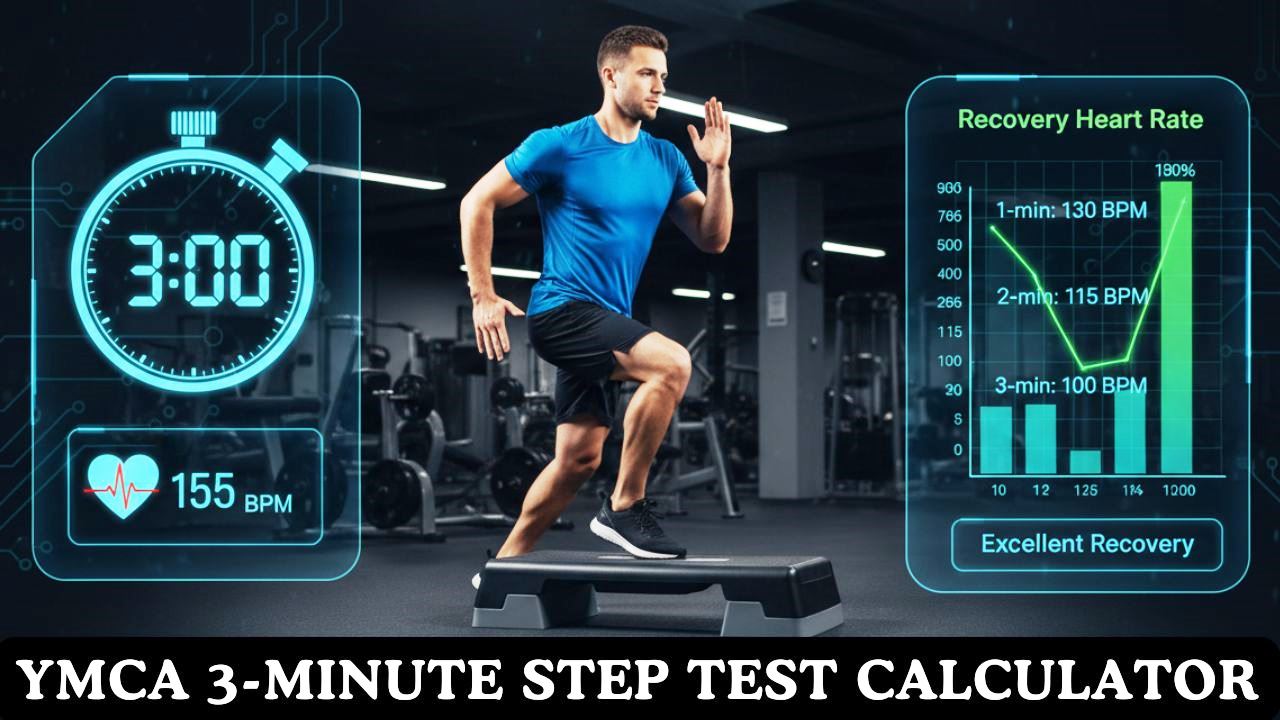
What is the YMCA 3-Minute Step Test?
The YMCA 3-Minute Step Test measures your aerobic (cardiovascular) fitness based on how quickly your heart rate returns to normal after exercise. This submaximal test estimates your VO2max using a 12-inch step and post-exercise heart rate recovery.
The test uses a 12-inch (30 cm) step height – significantly lower than the Queens College test (16.25 inches) – making it accessible for general populations, older adults, and beginners. The test has been scientifically validated with strong correlation (r = 0.80) to laboratory-measured VO2max.
Scientific Validation: Research published in the Journal of Lifestyle Medicine (2020) confirmed the validity of the YMCA test for estimating VO2max in healthy adults, demonstrating significant correlation with maximal exercise treadmill tests.
VO2max Prediction Formula
The YMCA test uses gender-specific equations to predict VO2max based on your heart rate recovery after the 3-minute stepping protocol. These formulas were derived from regression analysis comparing step test results to laboratory-measured VO2max.
Where:
- VO2max = Maximal oxygen uptake (ml/kg/min)
- Recovery HR = 1-minute post-exercise heart rate (BPM)
A 32-year-old male counts 132 beats in the 60-second recovery period:
VO2max = 111.33 – (0.42 × 132)
VO2max = 111.33 – 55.44
VO2max = 55.9 ml/kg/min
Result: “Excellent” fitness (30-39 age group)
YMCA Test Protocol – Step-by-Step Guide
Equipment Required
- 12-inch step (30.5 cm) – standard stair height
- Stopwatch or timer for 3 minutes
- Metronome set to 96 BPM
- Watch with second hand for pulse counting
Test Procedure
- Warm-up: 5 minutes of light activity and dynamic stretching
- Step Pattern: Four-beat cycle at 96 BPM
- Beat 1: Right foot UP
- Beat 2: Left foot UP (both feet on step)
- Beat 3: Right foot DOWN
- Beat 4: Left foot DOWN (both feet on ground)
- Duration: Continue stepping for exactly 3 minutes (180 seconds)
- Recovery: Immediately sit down upon completion
- Heart Rate Measurement: Within 5 seconds of stopping, count your pulse for a full 60 seconds
Step Cadence Details
The YMCA test uses a unified 96 BPM cadence for all participants, unlike the Queens College test which uses different cadences for men (96 BPM) and women (88 BPM). This simplifies the protocol and equipment setup.
Stepping Rate: 96 beats per minute = 24 complete step cycles per minute (4 beats per cycle)
What is VO2max and METs
VO2max (maximal oxygen uptake) represents the maximum amount of oxygen your body can utilize during intense exercise. It’s measured in milliliters of oxygen per kilogram of body weight per minute (ml/kg/min) and is considered the gold standard measure of cardiovascular fitness.
Why VO2max Matters:
- Health Predictor: Higher VO2max is associated with lower risk of cardiovascular disease, metabolic syndrome, and all-cause mortality
- Fitness Indicator: Reflects your heart, lungs, and muscles’ ability to deliver and use oxygen efficiently
- Performance Metric: Strong predictor of endurance performance in sports and daily activities
- Trainability: VO2max can improve 15-25% with proper aerobic training
MET Equivalent
METs (Metabolic Equivalents of Task) express exercise intensity relative to your resting metabolism. One MET equals your oxygen consumption at rest (approximately 3.5 ml/kg/min).
METs = VO2max ÷ 3.5
If your VO2max is 55.9 ml/kg/min:
METs = 55.9 ÷ 3.5 = 16.0 METs
This means your maximum capacity is 16 times your resting metabolic rate.
YMCA Heart Rate Recovery Scoring Tables
The YMCA provides age-adjusted standards based on your 1-minute recovery heart rate. Lower heart rate indicates better fitness – the fitter you are, the quicker your heart rate returns to normal after exercise.
Do NOT take pulse for 15 seconds and multiply by 4. This test uses recovery rate as the measure, and heart rate is highest in the first 15 seconds. Use the full 1-minute count for accurate results.
Men – Heart Rate Recovery (BPM)
| Age | Excellent | Good | Above Avg | Average | Below Avg | Poor | Very Poor |
|---|---|---|---|---|---|---|---|
| 18-25 | 50-76 | 79-84 | 88-93 | 95-100 | 102-107 | 111-119 | 124-157 |
| 26-35 | 51-76 | 79-85 | 88-94 | 96-102 | 104-110 | 114-121 | 126-161 |
| 36-45 | 49-76 | 80-88 | 92-98 | 100-105 | 108-113 | 116-124 | 130-163 |
| 46-55 | 56-82 | 87-93 | 95-101 | 103-111 | 113-119 | 121-126 | 131-159 |
| 56-65 | 60-77 | 86-94 | 97-100 | 103-109 | 111-117 | 119-128 | 131-154 |
| 65+ | 59-81 | 87-92 | 94-102 | 104-110 | 114-118 | 121-126 | 130-151 |
Women – Heart Rate Recovery (BPM)
| Age | Excellent | Good | Above Avg | Average | Below Avg | Poor | Very Poor |
|---|---|---|---|---|---|---|---|
| 18-25 | 52-81 | 85-93 | 96-102 | 104-110 | 113-120 | 122-131 | 135-169 |
| 26-35 | 58-80 | 85-92 | 95-101 | 104-110 | 113-119 | 122-129 | 134-171 |
| 36-45 | 51-84 | 89-96 | 100-104 | 107-112 | 115-120 | 124-132 | 137-169 |
| 46-55 | 63-91 | 95-101 | 104-110 | 113-118 | 120-124 | 126-132 | 137-171 |
| 56-65 | 60-92 | 97-103 | 106-111 | 113-118 | 119-127 | 129-135 | 141-174 |
| 65+ | 70-92 | 96-101 | 104-111 | 116-121 | 123-126 | 128-133 | 135-155 |
VO2max Fitness Classification (ACSM Standards)
The American College of Sports Medicine (ACSM) provides age and gender-specific VO2max norms to classify cardiovascular fitness. These represent population percentiles:
- Poor: Below 20th percentile – immediate fitness improvement needed
- Fair: 20-39th percentile – below average fitness level
- Average: 40-59th percentile – typical fitness for age and gender
- Good: 60-79th percentile – above average cardiovascular health
- Excellent: 80-89th percentile – superior aerobic fitness
- Superior: Above 90th percentile – elite-level cardiovascular capacity
These norms are derived from extensive population studies and provide meaningful benchmarks for tracking fitness progress over time.
YMCA vs Queens College Step Test
| Feature | YMCA | Queens College |
|---|---|---|
| Step Height | 12″ (30 cm) | 16.25″ (41.3 cm) |
| Cadence | 96 BPM (all) | 96 BPM (men), 88 BPM (women) |
| HR Measurement | 60-second count | 15-sec count × 4 |
| Difficulty | Moderate | High |
| Best For | Beginners, older adults, general population | Athletes, younger adults, high fitness |
When to Use YMCA Test:
- Age 50+ or limited mobility
- Beginner to intermediate fitness levels
- Home testing with standard stair step
- Corporate wellness or group fitness assessments
- Prefer more comfortable, less intense protocol
Interested in the more challenging alternative? Try our Queens College Step Test Calculator for comparison.
Frequently Asked Questions
How often should I retest my VO2max?
Retest every 4-6 weeks to track progress. More frequent testing isn’t recommended as VO2max improvements take time to manifest. Always test under similar conditions (time of day, hydration, rest status) for accurate comparisons.
Can I use a different step height?
No. The YMCA prediction equations are calibrated specifically for a 12-inch (30 cm) step. Using a different height will invalidate your results. If you need a higher step, consider the Queens College test instead.
Why count for 60 seconds instead of 15 seconds?
Counting for a full 60 seconds provides more accurate heart rate data with less room for multiplication error. While some tests use 15-second counts multiplied by 4, the YMCA protocol’s 60-second count reduces measurement variability.
Is the YMCA test accurate for athletes?
The YMCA test is moderately accurate for recreational athletes but may underestimate VO2max in highly trained individuals due to ceiling effects. Elite athletes should consider laboratory VO2max testing for precise measurements.
What if I can’t maintain the 96 BPM cadence?
If you struggle to maintain the cadence throughout the 3 minutes, this indicates your current fitness level may be below average. Complete the test at whatever pace you can sustain, but note that results may be less accurate. Consider the test a baseline and focus on improving your fitness before retesting.
