
Waist to Hip Ratio Calculator
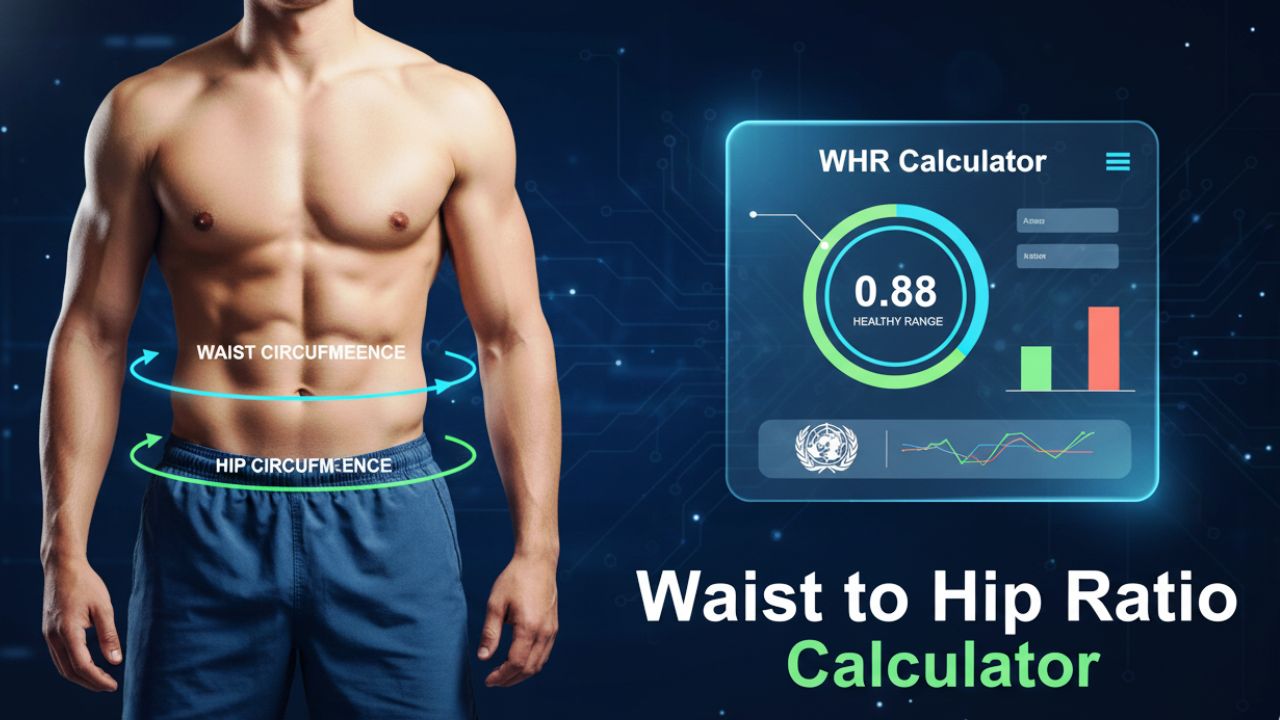
What is Waist-to-Hip Ratio (WHR)?
Waist-to-Hip Ratio (WHR) is a simple measurement that compares the size of your waist to your hips. It’s a powerful health screening tool endorsed by the World Health Organization (WHO) to assess body fat distribution and disease risk.
Unlike BMI, which only considers weight and height, WHR reveals where your body stores fat. This matters because abdominal fat (around your organs) is far more dangerous than fat stored in your hips and thighs.
The Science Behind WHR
WHR measures body fat distribution patterns. Two main types exist:
Android (Apple Shape): Fat concentrated around the abdomen. Common in men and postmenopausal women. This visceral fat surrounds vital organs and releases inflammatory substances that damage health.
Gynoid (Pear Shape): Fat stored in hips, thighs, and buttocks. More common in premenopausal women. This subcutaneous fat is metabolically safer and may even provide protective benefits.
Studies show that WHR is a stronger predictor of cardiovascular disease and mortality than BMI or waist circumference alone.
How to Calculate Waist-to-Hip Ratio
The WHR Formula
This simple division gives you a ratio that indicates your body fat distribution pattern and associated health risks.
Hips: 38 inches (97 cm)
WHR: 34 ÷ 38 = 0.89
Category: Excellent (below WHO threshold of 0.90 for men)
Health Risk: Low risk of cardiovascular disease
Hips: 36 inches (91 cm)
WHR: 32 ÷ 36 = 0.89
Category: High Risk (exceeds WHO threshold of 0.85 for women)
Health Risk: Increased risk of CVD, diabetes, and reproductive issues
WHO Health Risk Standards
WHO Risk Categories by Gender
The World Health Organization established different WHR thresholds for men and women based on extensive population studies.
| Category | Men (WHR) | Women (WHR) | Health Risk |
|---|---|---|---|
| Excellent | Below 0.90 | Below 0.80 | Low risk |
| Good | 0.90-0.94 | 0.80-0.84 | Moderate risk |
| High | 0.95-0.99 | 0.85-0.89 | Increased risk |
| Very High | 1.00+ | 0.90+ | Substantial risk |
Key Insight: Women naturally have wider hips for childbearing, so their healthy WHR threshold (0.85) is lower than men’s (0.90). This biological difference is reflected in WHO guidelines.
How to Measure Correctly
Waist Measurement
Location: Measure at the narrowest point of your torso, typically between the bottom of your ribs and the top of your hip bones (approximately at belly button level).
Technique:
• Stand upright with feet together
• Breathe out normally (don’t suck in or push out)
• Wrap tape measure around waist parallel to floor
• Tape should be snug but not compressing skin
• Record measurement at end of normal breath
Common Mistake: Measuring at the widest part of the belly instead of the natural waistline leads to inaccurate results.
Hip Measurement
Location: Measure at the widest part of your buttocks/hip area.
Technique:
• Stand with feet together
• Find the widest point of hips (usually 7-9 inches below waist)
• Wrap tape measure around fullest part of hips
• Keep tape parallel to floor
• Tape should lie flat and snug without compression
Tip: Use a mirror or ask someone to help ensure the tape is level all the way around.
Measurement Best Practices
Timing: Measure in the morning before eating or drinking for most consistent results.
Clothing: Wear minimal, thin clothing or measure directly on skin.
Frequency: Remeasure every 4 weeks to track progress. Daily variations are normal.
Tools: Use a flexible fabric tape measure (like those used for sewing). Metal carpenter’s tape measures are too rigid.
Consistency: Always measure at the same time of day in the same way to track meaningful changes.
Target WHR by Gender
Men’s WHR Targets
| Goal | Target WHR | Example Measurements |
|---|---|---|
| Optimal Health | Below 0.90 | Waist 34″ / Hips 38″ = 0.89 |
| Athletic | 0.80-0.88 | Waist 32″ / Hips 38″ = 0.84 |
| Bodybuilder | 0.75-0.85 | Waist 30″ / Hips 38″ = 0.79 |
| Action Needed | 0.90-0.95 | Reduce waist circumference |
| High Risk | Above 0.95 | Medical consultation required |
Note: Very muscular men (bodybuilders) may have WHR below 0.80 due to developed glutes and legs combined with narrow waist—this is healthy, not a concern.
Women’s WHR Targets
| Goal | Target WHR | Example Measurements |
|---|---|---|
| Optimal Health | Below 0.80 | Waist 28″ / Hips 36″ = 0.78 |
| Athletic | 0.70-0.78 | Waist 26″ / Hips 36″ = 0.72 |
| Fitness Model | 0.65-0.75 | Waist 25″ / Hips 37″ = 0.68 |
| Action Needed | 0.80-0.85 | Reduce waist circumference |
| High Risk | Above 0.85 | Medical consultation required |
Fertility Note: Research suggests optimal WHR for fertility is 0.70-0.80. Ratios above 0.85 are associated with reduced fertility and hormonal imbalances.
⚠️ Medical Disclaimer
This calculator is for educational and informational purposes only. It is not a substitute for professional medical advice, diagnosis, or treatment.
Pregnant women, individuals with scoliosis or hip disorders, and those with unusual body proportions should interpret results cautiously and discuss with their doctor.
Always seek guidance from a qualified healthcare professional before starting any diet, exercise, or weight loss program.
References
- Kościński, K. (2013). Assessment of Waist-to-Hip Ratio Attractiveness in Women: An Anthropometric Analysis of Digital Silhouettes. Archives of Sexual Behavior, 43(5), 989. https://doi.org/10.1007/s10508-013-0166-1
- Park, J. B., Choi, J., Na, J. Y., Kim, S. H., Park, H., Yang, S., & Cho, S. H. (2025). Evaluating waist-to-hip ratio in youth using frequency-modulated continuous wave radar and machine learning. Scientific Reports, 15(1), 1-11. https://doi.org/10.1038/s41598-025-88098-x
