
⏱️ Tempo & TUT Calculator
Master your Time Under Tension for maximum muscle growth and strength gains
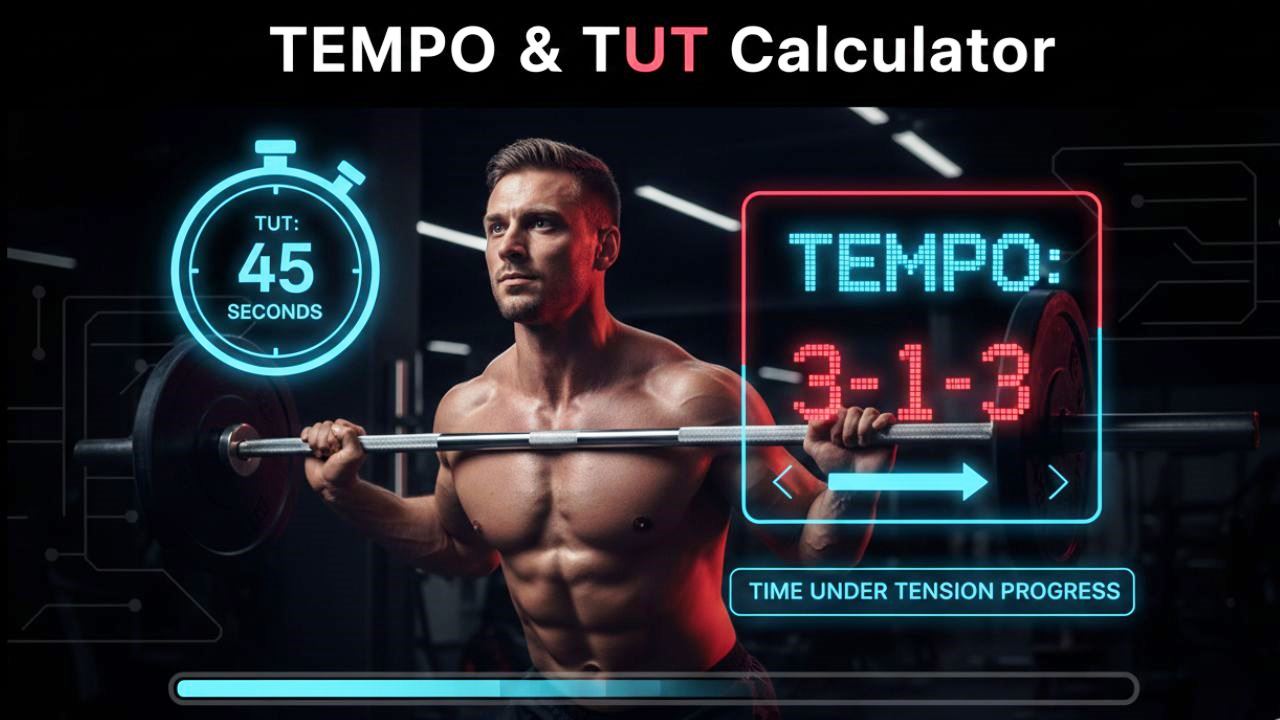
Training Tempo and Time Under Tension
What is Training Tempo?
Training tempo is the speed at which you perform each phase of an exercise. It’s written as a four-number code that tells you exactly how many seconds to spend on each part of the movement.
Think of tempo as your rep’s speed limit. Instead of just lifting and lowering the weight however feels natural, tempo training gives you precise control over every inch of the movement.
1 second: Hold at the bottom position
2 seconds: Lift the weight (concentric)
0 seconds: No pause at the top
Total Time Per Rep: 6 seconds
For 8 reps: 48 seconds of total tension
This simple notation system is used by coaches and trainers worldwide. Once you understand it, you can follow any tempo-based program with precision.
What is Time Under Tension (TUT)?
Time Under Tension is the total amount of time your muscles are working during a set. It’s calculated by multiplying your tempo per rep by the number of reps you perform.
Research shows that TUT is a key driver of muscle growth. When you keep your muscles under tension for the right amount of time, you create the mechanical stress and metabolic demand needed to trigger muscle protein synthesis.
Reps: 10 reps
TUT per Set: 6 × 10 = 60 seconds
If you do 3 sets, your total TUT is 180 seconds (3 minutes)
According to research published in the Journal of Strength and Conditioning Research, controlling TUT is one of the most effective ways to manipulate training volume and intensity for specific adaptations.
Optimal TUT Ranges for Different Goals
Different training goals require different amounts of time under tension. Here’s what the science says about optimal TUT ranges:
For Building Strength (20-40 seconds per set)
Strength training requires heavy weights with lower reps. The TUT is shorter because you’re focusing on lifting maximum loads. This range optimizes neural adaptations and improves your ability to produce force quickly.
- Rep Range: 1-6 reps
- Tempo Example: 2-0-1-0 (explosive concentric)
- Why It Works: Short TUT with heavy loads trains your nervous system to recruit more muscle fibers
For Muscle Growth (40-70 seconds per set)
This is the sweet spot for hypertrophy. Research by Schoenfeld (2010) found that moderate TUT (40-70 seconds) maximizes both mechanical tension and metabolic stress, the two main drivers of muscle growth.
- Rep Range: 6-12 reps
- Tempo Example: 3-1-2-0 or 4-0-2-1
- Why It Works: Enough time to accumulate metabolic byproducts while maintaining sufficient load
For Muscular Endurance (70-120 seconds per set)
Endurance training requires lighter weights with higher reps. The extended TUT improves your muscles’ ability to resist fatigue and work for longer periods.
- Rep Range: 12-25+ reps
- Tempo Example: 2-0-2-0
- Why It Works: Extended TUT improves oxidative capacity and fatigue resistance
To maximize your results, combine tempo training with proper workout intensity management to ensure you’re training at the right effort level.
The Four Phases of Tempo Training
Understanding each phase helps you apply tempo training correctly to any exercise:
1. Eccentric Phase (Lowering/Lengthening)
This is when your muscle lengthens under load. In a squat, it’s the lowering phase. In a pull-up, it’s the lowering back down. The eccentric phase is crucial for muscle growth because it creates significant muscle damage (in a good way) that triggers adaptation.
Key Point: Research shows the eccentric phase can be up to 1.5 times stronger than the concentric phase. Slowing down this phase (3-5 seconds) increases time under tension without needing heavier weights.
2. Pause at Bottom (Stretch Position)
Holding at the bottom stretch position increases difficulty and eliminates momentum. A 1-2 second pause ensures you’re controlling the weight rather than bouncing out of the bottom.
Key Point: Pausing at the bottom is especially effective for muscle growth because it maintains tension at the muscle’s most lengthened position.
3. Concentric Phase (Lifting/Shortening)
This is the lifting phase where your muscle shortens. In a squat, it’s standing back up. The speed here depends on your goal: explosive for power, controlled for hypertrophy.
Key Point: For muscle growth, a 2-3 second concentric works well. For strength and power, aim for explosive (1 second or “X” for maximum speed).
4. Pause at Top (Contracted Position)
Holding at the top squeezes the muscle in its fully contracted state. This isn’t always necessary, but can enhance the mind-muscle connection.
Key Point: A 0-1 second pause at the top is typical. Longer pauses can increase TUT but may cause excessive fatigue.
Common Tempo Prescriptions and When to Use Them
Different tempos create different training effects. Here are the most common tempo prescriptions and their applications:
2-0-2-0 (Standard Controlled Tempo)
Total TUT: 4 seconds per rep
Best For: General strength training, beginners learning form
Why Use It: Balanced tempo that works for most exercises and goals
3-1-2-0 (Hypertrophy Focus)
Total TUT: 6 seconds per rep
Best For: Muscle building, intermediate lifters
Why Use It: Emphasizes eccentric phase and eliminates momentum with bottom pause
4-0-2-1 (Advanced Hypertrophy)
Total TUT: 7 seconds per rep
Best For: Advanced muscle building, breaking plateaus
Why Use It: Maximizes TUT with slow eccentric and peak contraction hold
5-2-1-0 (Eccentric-Emphasized)
Total TUT: 8 seconds per rep
Best For: Building strength in the eccentric phase, injury prevention
Why Use It: Super slow eccentric with pause creates maximum muscle damage stimulus
2-0-1-0 (Power Development)
Total TUT: 3 seconds per rep
Best For: Athletic performance, explosive strength
Why Use It: Controlled eccentric with explosive concentric trains rate of force development
1-0-X-0 (Maximum Power)
Total TUT: Variable (very short)
Best For: Olympic lifts, plyometrics, speed work
Why Use It: Explosive throughout for maximum power output (X = as fast as possible)
For comprehensive training planning, start with proper warm-up protocols before implementing these tempo prescriptions.
How to Apply Tempo Training to Your Workouts
Implementing tempo training is straightforward once you understand the basics. Here’s how to get started:
Step 1: Choose Your Goal
Start by identifying what you want to achieve. Are you building muscle, getting stronger, or improving endurance? Your goal determines your ideal TUT range.
Step 2: Select Appropriate Weight
When you add tempo control, you’ll need to reduce the weight you normally use. A good rule of thumb: reduce your typical weight by 10-20% when first adding tempo work.
Step 3: Count Mentally or Use Audio Cues
Count the seconds in your head (one-one-thousand, two-one-thousand) or use a metronome app set to 1-second beeps. After a few sessions, the timing becomes natural.
Step 4: Start with Compound Movements
Apply tempo training to your main lifts first: squats, deadlifts, bench press, rows. These exercises give you the most return on investment.
Step 5: Track Your Progress
Keep a log of your tempo, weight, sets, and reps. Progress by either adding weight, adding reps, or slowing down the tempo over time. Use sets and reps calculators to plan your progression systematically.
Sample Tempo Training Program
Here’s a practical example of how to structure a workout using tempo training for muscle growth:
Tempo: 3-1-2-0 | Sets: 4 | Reps: 8
TUT per set: 48 seconds | Total TUT: 192 seconds
Exercise 2: Romanian Deadlifts
Tempo: 3-1-1-0 | Sets: 3 | Reps: 10
TUT per set: 50 seconds | Total TUT: 150 seconds
Exercise 3: Leg Press
Tempo: 2-0-2-1 | Sets: 3 | Reps: 12
TUT per set: 60 seconds | Total TUT: 180 seconds
Exercise 4: Leg Curls
Tempo: 3-1-2-0 | Sets: 3 | Reps: 12
TUT per set: 72 seconds | Total TUT: 216 seconds
Total Workout TUT: 738 seconds (12.3 minutes)
Total Hard Sets: 13 sets for legs
This workout keeps each set in the optimal 40-70 second TUT range for hypertrophy while accumulating enough total volume for muscle growth.
