
Shoulder to Height Ratio Calculator
What is Shoulder-to-Height Ratio?
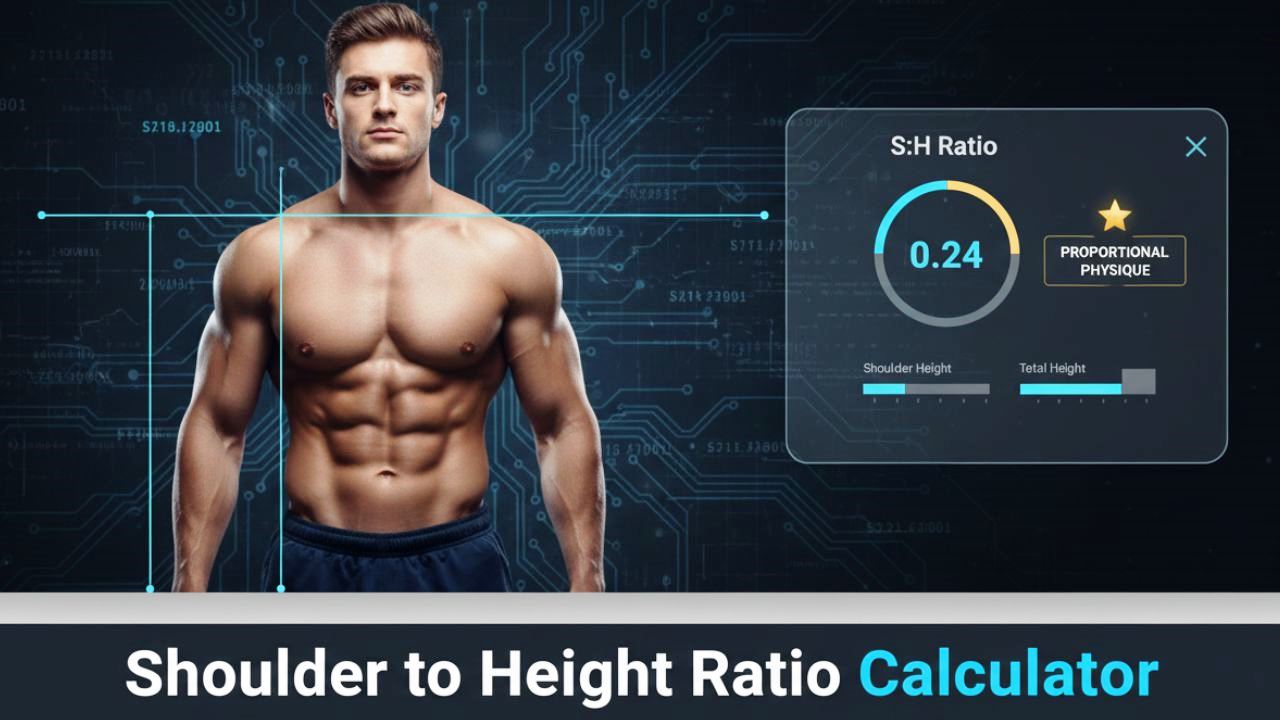
Shoulder-to-Height Ratio compares your skeletal shoulder width (bone-to-bone) to your total height. This ratio is used in anthropometry, sports science, ergonomics, and tailoring to classify body frame size.
Unlike shoulder circumference measurements (which include muscle), this ratio measures your bi-acromial width—the distance between the bony points at the ends of your collarbones (clavicles).
Why It Matters: Frame size is genetic and unchangeable. Understanding your frame helps set realistic expectations for muscle building, choose proper clothing sizes, and optimize training strategies.
The Science Behind Frame Size
Your frame size is determined by skeletal structure—specifically clavicle (collarbone) length, bone thickness, and joint size. These are set by genetics during growth and cannot be changed in adulthood.
Three Frame Categories:
Small Frame: Narrow clavicles, thin bones, smaller joints. Typically ectomorph body type. Natural advantage: easier to look defined. Challenge: harder to build visible muscle mass.
Medium Frame: Average bone structure. Most common category. Balanced potential for both muscle gain and definition.
Large Frame: Wide clavicles, thick bones, larger joints. Typically mesomorph body type. Natural advantage: easier to build muscle mass and strength. Challenge: requires more muscle to look defined.
How to Calculate Shoulder-to-Height Ratio
The Formula
Both measurements should be in the same units (inches or centimeters). The result is typically expressed as a decimal (e.g., 0.245) or percentage (e.g., 24.5% of height).
Shoulder Width: 17 inches (43 cm)
Ratio: 17 ÷ 70 = 0.243
Frame: Medium (ratio 0.235-0.255 for men)
Result: Balanced skeletal proportions
Shoulder Width: 16 inches (41 cm)
Ratio: 16 ÷ 65 = 0.246
Frame: Large (ratio >0.240 for women)
Result: Athletic skeletal structure
Frame Size Classification Standards
Men’s Frame Size Standards
| Frame Size | Ratio Range | Shoulder Width @ 70″ Height | Description |
|---|---|---|---|
| Small | Below 0.235 | Below 16.5 inches | Narrow skeletal structure, slim build |
| Medium | 0.235-0.255 | 16.5-17.9 inches | Average proportions, balanced frame |
| Large | Above 0.255 | Above 17.9 inches | Broad skeletal structure, athletic build |
Note: These are bone-to-bone measurements, not shoulder circumference. A man with 48-inch shoulder circumference might only have 17-inch bi-acromial width.
Women’s Frame Size Standards
| Frame Size | Ratio Range | Shoulder Width @ 65″ Height | Description |
|---|---|---|---|
| Small | Below 0.220 | Below 14.3 inches | Delicate bone structure, petite build |
| Medium | 0.220-0.240 | 14.3-15.6 inches | Average proportions, balanced frame |
| Large | Above 0.240 | Above 15.6 inches | Athletic bone structure, broad build |
Note: Women naturally have narrower shoulders relative to height than men. A “large frame” for a woman (0.250 ratio) would be “small” for a man. This is skeletal dimorphism.
How to Measure Correctly
Measuring Bi-Acromial Shoulder Width
What to Measure: The distance between the bony points at the outer ends of your collarbones (acromion processes). This is bone-to-bone width, NOT circumference around shoulders.
Technique:
• Stand upright with relaxed posture
• Arms hanging naturally at sides
• Feel for the bony points at the tops of your shoulders
• Measure straight across from point to point
• Use a rigid ruler or calipers (not tape measure)
• Record to nearest 0.1 inch or 0.5 cm
Best Method: Have someone help or stand against a wall with arms at sides, marking the bone points, then measuring distance.
Common Mistake: Measuring shoulder circumference (around deltoid muscles) instead of bone-to-bone width. Circumference can be 45-50 inches while bone width is only 15-18 inches.
Measuring Height
Technique:
• Remove shoes
• Stand against flat wall
• Heels, buttocks, shoulders touching wall
• Look straight ahead (Frankfort plane)
• Place flat object (book) on top of head
• Mark wall, measure from floor to mark
Best Time: Measure in the morning. You can be 0.5-1 inch shorter in evening due to spinal compression during the day.
Consistency: Always measure the same way for accurate tracking over time.
Measurement Tips
Accuracy Matters: Even 0.5-inch error in shoulder width significantly affects ratio calculation (0.235 vs 0.243 is different frame classification).
Professional Measurement: For most accurate assessment, visit a sports medicine clinic or anthropometry lab. They use specialized calipers.
Self-Measurement: If measuring yourself, use a mirror and take multiple measurements. Average the results.
Age Factor: Frame size doesn’t change after growth plates close (age 18-21). Adults maintain same ratio throughout life unless bone disease occurs.
⚠️ Important Disclaimer
This calculator assesses skeletal frame size for informational and fitness planning purposes.
Frame size is genetic and cannot be changed. This tool does not assess health risks or medical conditions. It is not a diagnostic tool.
Measurements should be bone-to-bone shoulder width (bi-acromial), not shoulder circumference. Incorrect measurements lead to inaccurate classifications.
Frame size is one factor in body composition. It does not determine your ability to build muscle, lose fat, or achieve fitness goals. All frame sizes can develop impressive physiques with proper training and nutrition.
If you have concerns about bone structure, growth patterns, or skeletal abnormalities, consult an orthopedic specialist or sports medicine physician.
