
🏋️ RPE to %1RM Calculator
Convert between RPE ratings and percentage of 1RM. Get personalized training recommendations.
What is RPE and %1RM in Training
What is RPE (Rate of Perceived Exertion)?
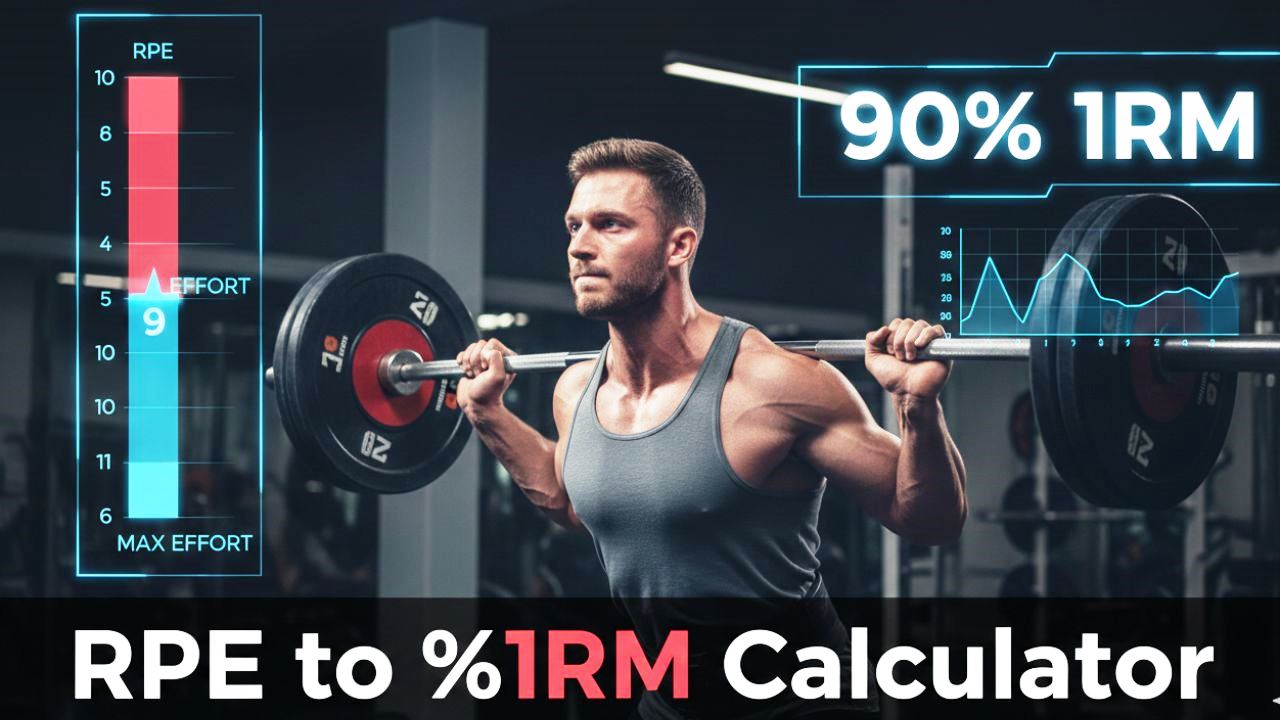
RPE stands for Rate of Perceived Exertion. It’s a simple way to measure how hard your workout feels based on how many more reps you could do before reaching failure. This is also called Reps in Reserve (RIR).
For example, if you finish a set and feel like you could do 2 more reps before failing, that’s an RPE of 8. This system was popularized by Mike Tuchscherer and is widely used in strength training and powerlifting.
What is %1RM (Percentage of One-Rep Max)?
%1RM refers to a percentage of your one-rep maximum – the maximum weight you can lift for a single repetition with proper form. This is a traditional method for programming training loads.
For example, if your 1RM on the bench press is 300 lbs, then 80% of 1RM would be 240 lbs. Different percentages correspond to different rep ranges and training goals.
If your 1RM is 300 lbs and you want to train at 75%:
Weight to Use = 300 × 0.75 = 225 lbs
At this intensity, you’d typically be able to perform 6-10 reps, which is optimal for muscle growth (hypertrophy).
The Connection Between RPE and %1RM
Here’s the important part: RPE and %1RM are connected, but the relationship changes based on how many reps you’re doing.
For example, an RPE of 8 (2 reps left) might mean:
- 92% of 1RM if you’re doing 1 rep
- 84% of 1RM if you’re doing 3 reps
- 78% of 1RM if you’re doing 5 reps
- 69% of 1RM if you’re doing 8 reps
This is why our calculator asks for both RPE and the number of reps – we need both pieces of information to accurately convert to a percentage.
How to Use This Calculator
Mode 1: RPE to %1RM
Use this when you know your RPE and want to know what percentage of your 1RM you’re using.
- Enter how many reps you performed
- Select your RPE (how hard it felt)
- Optionally enter your 1RM to see the actual weight you should use
- Click “Convert to %1RM” to see your results
Mode 2: %1RM to RPE
Use this when you have a percentage-based program and want to know what RPE to aim for.
- Enter the percentage of 1RM (e.g., 75%)
- Enter how many reps you plan to do
- Click “Convert to RPE” to see what RPE you should expect
Mode 3: Full RPE Chart
Generate a complete reference chart showing the percentage of 1RM for every combination of reps (1-12) and RPE (6-10). This is perfect for:
- Printing and keeping in your gym bag for quick reference
- Understanding the full relationship between RPE and %1RM
- Planning your training program
- Getting actual weights if you enter your 1RM
Why Use RPE Instead of Just Percentages?
Both methods work, but RPE has some major advantages:
- Autoregulation: Your strength fluctuates day-to-day based on sleep, stress, and recovery. RPE lets you adjust automatically – if you’re having a bad day, RPE 8 might be lighter than usual, and that’s okay.
- No 1RM Testing Required: You don’t need to know your exact 1RM to use RPE effectively. This is safer and more practical for most people.
- Beginner-Friendly: New lifters can understand “leave 2 reps in the tank” more easily than calculating percentages.
- Progressive Overload: You can track progress by doing the same RPE with more weight over time, without constantly retesting your 1RM.
Scientific studies have shown that RPE-based training produces similar or better results compared to percentage-based training, especially for intermediate and advanced lifters.
Common Training Goals and Recommended RPE/Intensity
For Building Muscle (Hypertrophy)
Target: 67-85% of 1RM, RPE 7-9
Rep Range: 6-12 reps
Why: This intensity provides enough stimulus for muscle growth without excessive fatigue. Most sets should be RPE 7-8 (2-3 reps left) with some harder sets at RPE 9.
For Building Strength
Target: 85-95% of 1RM, RPE 8-10
Rep Range: 1-6 reps
Why: Heavy weights are needed to build maximal strength. Training regularly at RPE 9-10 can be fatiguing, so mix in some RPE 8 sets.
For Muscular Endurance
Target: 50-67% of 1RM, RPE 6-8
Rep Range: 12-20+ reps
Why: Lighter weights for higher reps improve your muscles’ ability to work for longer periods. RPE is especially useful here because counting reps in reserve gets harder with high-rep sets.
⚠️ Important Disclaimers
Individual Variation: The RPE to %1RM conversions shown in this calculator are based on research averages. Your personal response may vary by ±5-10% depending on your training experience, muscle fiber type, and recovery status.
Exercise Specificity: These percentages are most accurate for compound movements like squats, bench presses, and deadlifts. Isolation exercises and machine movements may vary.
Training Experience: Beginners may need to use slightly lower percentages (2-5% less) due to less efficient motor patterns and technique.
Daily Fluctuations: Your RPE for a given percentage can change based on sleep quality, nutrition, stress, and recovery. This is normal and expected. Always prioritize how you feel on that specific day.
Related Resources
To get the most out of your training, check out these complementary tools:
- Workout Intensity Calculator – Calculate training intensity using %1RM, RPE, or heart rate methods
