
🏃 Queens College Step Test Calculator
Assess your aerobic fitness and estimate VO2max with the validated 3-minute step test. Includes interactive timer, pulse counter, and comprehensive fitness analysis.
- Take your heart rate in the standing position within 5 seconds of finishing your last step.
- Count your pulse for 15 seconds and multiply by 4.
Example: 33 × 4 = 132 bpm (*33 is the 15 second pulse count)
These norms are based on ACSM (American College of Sports Medicine) guidelines and represent population averages for healthy adults.
Men – VO2max (ml/kg/min)
| Age | Poor <20% |
Fair 20-39% |
Average 40-59% |
Good 60-79% |
Excellent 80-89% |
Superior >90% |
|---|---|---|---|---|---|---|
| 20-29 | <33 | 33-36 | 37-41 | 42-46 | 47-52 | >52 |
| 30-39 | <31 | 31-35 | 36-40 | 41-45 | 46-51 | >51 |
| 40-49 | <30 | 30-33 | 34-38 | 39-43 | 44-49 | >49 |
| 50-59 | <26 | 26-30 | 31-35 | 36-40 | 41-46 | >46 |
| 60+ | <20 | 20-26 | 27-32 | 33-38 | 39-44 | >44 |
Women – VO2max (ml/kg/min)
| Age | Poor <20% |
Fair 20-39% |
Average 40-59% |
Good 60-79% |
Excellent 80-89% |
Superior >90% |
|---|---|---|---|---|---|---|
| 20-29 | <28 | 28-31 | 32-36 | 37-41 | 42-47 | >47 |
| 30-39 | <27 | 27-30 | 31-35 | 36-40 | 41-46 | >46 |
| 40-49 | <25 | 25-28 | 29-33 | 34-38 | 39-44 | >44 |
| 50-59 | <21 | 21-24 | 25-29 | 30-34 | 35-41 | >41 |
| 60+ | <17 | 17-20 | 21-25 | 26-30 | 31-37 | >37 |
Why it matters: Higher VO2max = better cardiovascular health, improved endurance, easier daily activities, and reduced risk of chronic disease. Research shows VO2max is one of the strongest predictors of longevity.
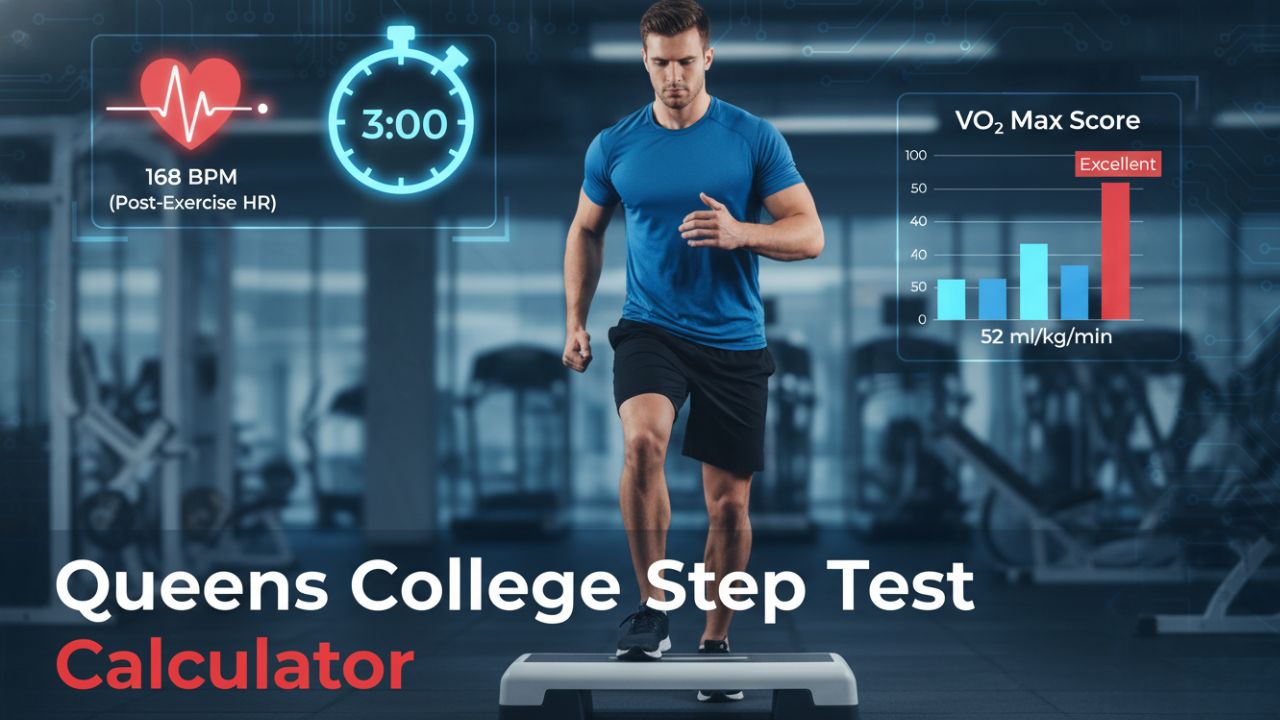
What is the Queens College Step Test?
The Queens College Step Test is a submaximal aerobic fitness test developed to estimate VO2max (maximal oxygen consumption) without requiring expensive lab equipment or testing to exhaustion. Validated by McArdle et al. in 1972, this 3-minute step test uses your post-exercise heart rate recovery to accurately estimate cardiovascular fitness.
The test requires minimal equipment—a 16.25-inch step, a timer, and the ability to measure your pulse. This makes it practical for home use, fitness assessments, and tracking aerobic fitness improvements over time.
The Science: McArdle Formulas
Research by W.D. McArdle and colleagues established validated equations for estimating VO2max from post-exercise heart rate. The formulas differ by gender because men and women have different cardiovascular responses to exercise.
📐 VO2max Prediction Formulas
Where: Recovery HR = Heart rate measured for 15 seconds (starting 5 seconds post-test) × 4, or 5 seconds × 12
📝 Example Calculation
Post-test pulse count: 20 beats in 5 seconds
Step 1: Calculate Recovery HR
Recovery HR = 20 × 12 = 120 BPM
Step 2: Apply female formula
VO2max = 65.81 – (0.1847 × 120)
VO2max = 65.81 – 22.16
VO2max = 43.65 ml/kg/min
Result: This woman has a VO2max of 43.65 ml/kg/min, placing her in the “Excellent” fitness category for her age group.
Test Protocol Requirements
Equipment Needed
- Step height: 16.25 inches (41.3 cm) – standard gym bleacher height
- Timer: Stopwatch or phone timer for 3-minute test
- Metronome: Optional but helpful for maintaining cadence
- Pulse measurement: Watch with second hand or heart rate monitor
Step Cadence
Step Pattern: The test uses a 4-beat cycle: Up (right foot), Up (left foot), Down (right foot), Down (left foot). Each complete cycle counts as one step. The metronome beats at 4× the step rate because each step has 4 movements.
What is VO2max?
Why VO2max Matters
- Health predictor: Higher VO2max is associated with lower risk of cardiovascular disease and all-cause mortality
- Fitness indicator: Reflects your body’s ability to deliver and use oxygen during exercise
- Performance marker: Directly relates to endurance performance in activities like running, cycling, and swimming
- Trainable: VO2max can improve 5-15% with proper aerobic training over 8-12 weeks
VO2max and MET Equivalents
MET (Metabolic Equivalent of Task) represents the energy cost of physical activities. One MET equals resting oxygen consumption of 3.5 ml/kg/min.
Example: A VO2max of 45 ml/kg/min equals 45 ÷ 3.5 = 12.9 METs. This person can work at 12.9 times their resting metabolic rate.
Fitness Classification Norms
The American College of Sports Medicine (ACSM) provides age and gender-specific norms for VO2max. These classifications help you understand how your aerobic fitness compares to population averages.
Men – VO2max (ml/kg/min)
| Age | Poor | Fair | Average | Good | Excellent | Superior |
|---|---|---|---|---|---|---|
| 20-29 | <33 | 33-36 | 37-41 | 42-46 | 47-52 | >52 |
| 30-39 | <31 | 31-35 | 36-40 | 41-45 | 46-51 | >51 |
| 40-49 | <30 | 30-33 | 34-38 | 39-43 | 44-49 | >49 |
| 50-59 | <26 | 26-30 | 31-35 | 36-40 | 41-46 | >46 |
| 60+ | <20 | 20-26 | 27-32 | 33-38 | 39-44 | >44 |
Women – VO2max (ml/kg/min)
| Age | Poor | Fair | Average | Good | Excellent | Superior |
|---|---|---|---|---|---|---|
| 20-29 | <28 | 28-31 | 32-36 | 37-41 | 42-47 | >47 |
| 30-39 | <27 | 27-30 | 31-35 | 36-40 | 41-46 | >46 |
| 40-49 | <25 | 25-28 | 29-33 | 34-38 | 39-44 | >44 |
| 50-59 | <21 | 21-24 | 25-29 | 30-34 | 35-41 | >41 |
| 60+ | <17 | 17-20 | 21-25 | 26-30 | 31-37 | >37 |
Source: American College of Sports Medicine (ACSM) Guidelines for Exercise Testing and Prescription
How to Improve Your VO2max
VO2max is highly trainable. With consistent aerobic training, expect 5-15% improvement in 8-12 weeks. The most effective training methods include:
🏃 High-Intensity Interval Training (HIIT)
Alternating high-intensity bursts (85-95% max HR) with recovery periods. Example: 4×4 minutes at 90% max HR with 3-minute recovery. Research shows HIIT is highly effective for VO2max gains.
💚 Zone 2 Training
Long, steady aerobic sessions at 60-70% max HR for 45-90 minutes. Builds mitochondrial density and aerobic base. Aim for 2-4 hours per week of Zone 2 training.
⏱️ Tempo Training
Sustained efforts at 70-80% max HR for 20-40 minutes. Improves lactate threshold and aerobic capacity.
🚴 Cross-Training
Combining running, cycling, swimming, and rowing develops well-rounded cardiovascular fitness while reducing injury risk.
⚠️ Safety Considerations
Do NOT perform this test if you have:
- Uncontrolled high blood pressure
- Recent heart attack or cardiac event
- Chest pain or angina
- Severe shortness of breath at rest
- Joint or balance problems
- Doctor’s advice against vigorous exercise
Stop immediately if you experience: chest pain, severe shortness of breath, dizziness, nausea, or irregular heartbeat.
