
Ideal Calf Size Calculator
Find your realistic calf measurements based on your body structure and training goals
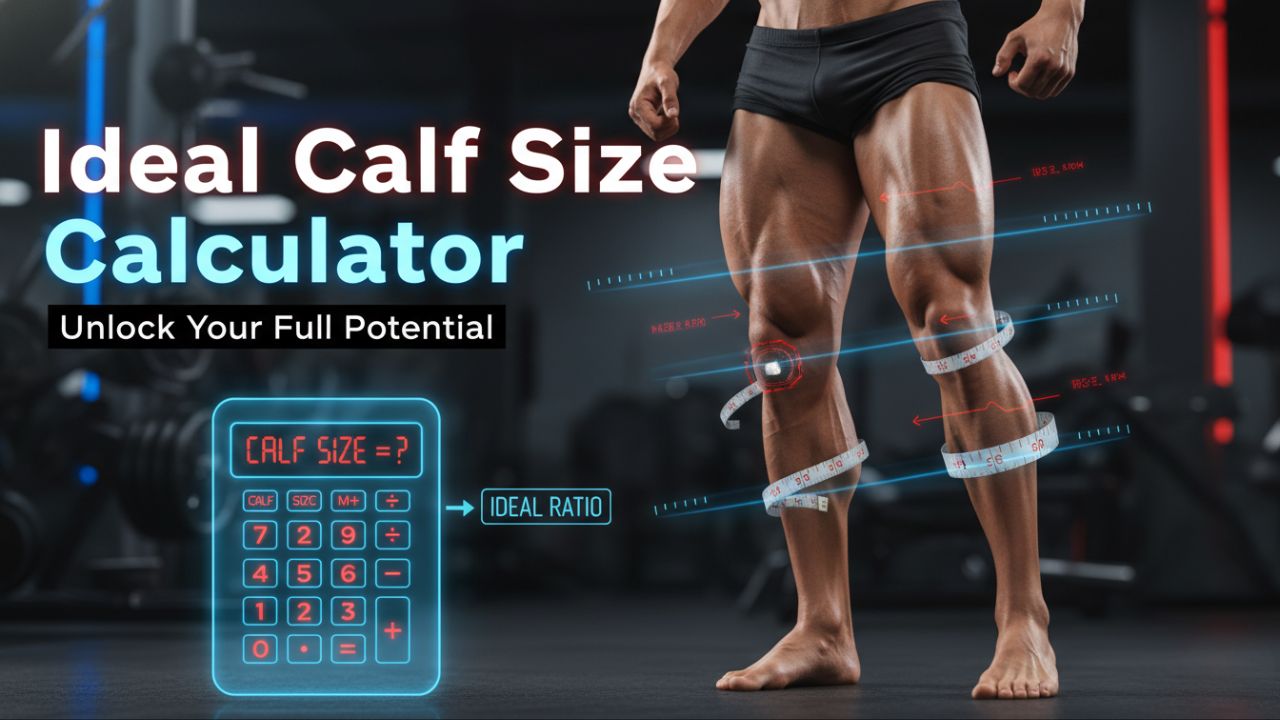
What is Ideal Calf Size?
Ideal calf size means having calves that look balanced with your height and body type. It’s about building muscle that matches your natural bone structure and helps you move better.
Unlike other muscles, calves are very affected by your genetics. Your bone thickness and how your muscles attach to your bones play a big role in how big your calves can get.
People with thinner bones usually have a harder time building big calves. Those with thicker bones often find it easier to develop calf muscle.
Why Your Genetics Matter So Much
Bone Thickness: Your wrist circumference is the best predictor of calf potential. If your wrists measure 6.3 inches (16 cm), you might reach about 16.1-16.9 inches (41-43 cm) naturally. With 7.1 inch (18 cm) wrists, you could develop 17.7-19.3 inches (45-49 cm) with dedicated training.
Muscle Insertion Points: The attachment point of your Achilles tendon determines calf growth capacity. High insertions create shorter muscle bellies that limit potential. Low insertions allow longer muscle bellies with greater development capacity. This genetic factor cannot be altered through training.
Daily Adaptation: Calves function constantly for ambulation and postural stability. They develop exceptional fatigue resistance and adapt to continuous low-intensity work. This adaptation makes them highly resistant to hypertrophy from conventional training stimuli, requiring specialized high-volume protocols to overcome baseline conditioning.
How to Calculate Ideal Calf Size
Calculation: 71 × 0.215 = 15.3 inches (38.7 cm)
Result: Balanced calf size for your height
Calculation: 65 × 0.20 = 13.0 inches (33.0 cm)
Result: Good proportions for your height
Calculation: 6.9 × 2.6 = 17.9 inches (45.5 cm)
Result: Your natural maximum after years of training
Calculation: 6.1 × 2.4 = 14.6 inches (37.2 cm)
Result: Your genetic upper limit
Calculation: 8.7 × 1.8 = 15.7 inches (39.6 cm)
Result: Good lower leg proportions
Wrist Method: 17.9 inches (45.5 cm)
Combined: 16.6 inches (42.1 cm) average
Adjusted: 16.4 inches (41.6 cm) for body type
Final: 16.4 inches (41.6 cm) for your goals
How to Measure Calves Correctly
Accurate Calf Measurement Technique
Step 1: Stand with feet hip-width apart, weight evenly distributed.
Step 2: Keep leg straight and relaxed (don’t contract calf muscles).
Step 3: Locate widest point of calf (typically mid-calf, below knee bulge).
Step 4: Wrap tape measure around calf at widest point, parallel to floor.
Step 5: Keep tape snug but not compressing muscle tissue.
Step 6: Record measurement during normal breathing.
Step 7: Measure both calves and use the larger measurement.
Common Mistakes: Don’t flex your calves during measurement, as this inflates the reading. Avoid measuring right after training when muscles are pumped up.
Average Calf Sizes (Reference Data)
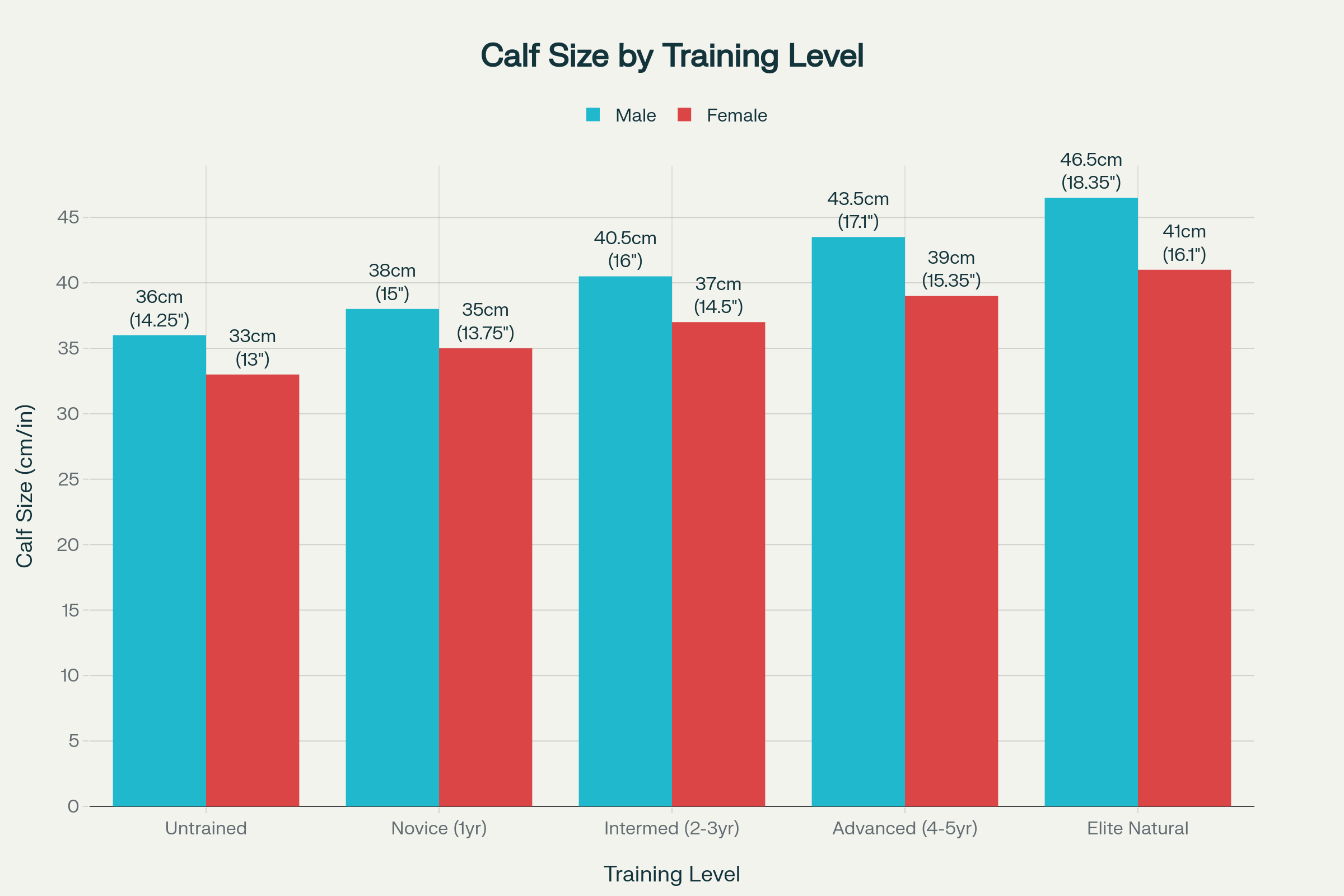
Average calf measurements across different training levels
| Training Level | Male Average | Female Average | Description |
|---|---|---|---|
| Untrained | 13.8-14.6 inches (35-37 cm) |
12.6-13.4 inches (32-34 cm) |
Average adult with no resistance training |
| Novice (1 year) | 14.6-15.4 inches (37-39 cm) |
13.4-14.2 inches (34-36 cm) |
Consistent training, modest gains |
| Intermediate (2-3 years) | 15.4-16.5 inches (39-42 cm) |
14.2-15.0 inches (36-38 cm) |
Solid calf development, visible muscle |
| Advanced (4-5 years) | 16.5-17.7 inches (42-45 cm) |
15.0-15.7 inches (38-40 cm) |
Excellent development, approaching genetic limit |
| Elite Natural | 17.7-18.9 inches (45-48 cm) |
15.7-16.5 inches (40-42 cm) |
Near maximum genetic potential, rare naturally |
Frequently Asked Questions
Why won’t my calves grow despite training?
Multiple interconnected factors limit calf hypertrophy: insufficient training volume (requires 20-30 sets per week minimum), inadequate training frequency (3-4 sessions weekly), incomplete range of motion (critical deep stretch phase), absence of progressive overload (systematic weight progression), genetic structural limitations (bone thickness determines upper limits), and unrealistic temporal expectations (0.5-1 cm annual growth maximum for natural trainees).
Most critically, calves develop extreme adaptation to daily ambulation and postural demands. This baseline conditioning creates exceptional fatigue resistance that requires extraordinary training volume to overcome. Individuals with smaller bone structure (wrist circumference under 6.3 inches/16 cm) face proportionally reduced maximum potential regardless of training dedication or methodology.
What’s the best rep range for calf growth?
Implement multiple rep ranges strategically: gastrocnemius (standing calf raises) demonstrates optimal hypertrophy across both moderate (8-12 reps) and higher (15-20 reps) ranges when using progressively heavier loads. Soleus (seated calf raises) responds preferentially to higher repetition ranges (12-20+ reps) due to its elevated slow-twitch fiber composition and postural function.
Structure your program with comprehensive rep range coverage: initiate with heavy standing raises (3-4 sets × 8-12 reps for mechanical tension), progress to moderate standing raises (2-3 sets × 15-20 reps for metabolic stress), and conclude with seated raises (4-5 sets × 12-20 reps for soleus specialization). This multi-range approach ensures complete gastrocnemius and soleus development while maximizing hypertrophic response.
Do genetics really limit calf size that much?
Absolutely—calves exhibit the strongest genetic determination among all muscle groups. Comprehensive research demonstrates calf circumference maxima correlate with wrist and ankle bone thickness at coefficients of 0.7-0.8. Your natural ceiling approximates wrist circumference × 2.5-2.7, representing an immutable structural constraint.
Individuals with 6.3 inch (16 cm) wrists typically achieve 15.7-16.9 inches (40-43 cm) as their genetic maximum; those with 7.5 inch (19 cm) wrists can attain 18.9-20.1 inches (48-51 cm). Tendon insertion height exerts additional influence—high-inserted calves (shortened muscle bellies, elongated tendons) demonstrate reduced growth capacity compared to low-inserted variants.
These anatomical factors remain 100% genetically predetermined and training-irresponsive. While optimized training protocols can achieve your predetermined maximum potential, they cannot transcend structural limitations imposed by skeletal architecture and connective tissue morphology.
How long to build 16-inch (40 cm) calves?
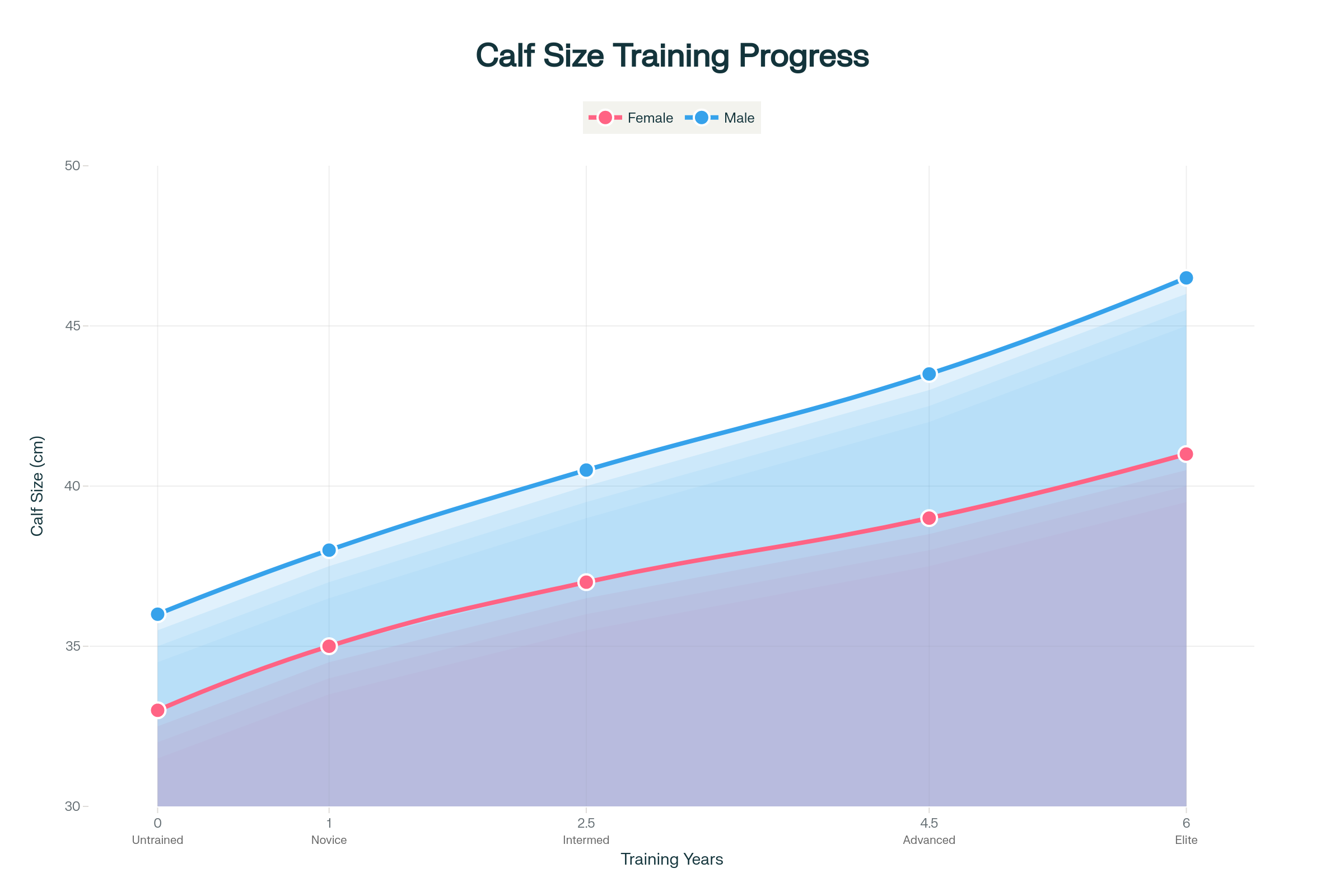
Typical calf growth progression over time
Timeline varies dramatically based on baseline measurements and genetic architecture. Beginning from average 13.8-14.6 inches (35-37 cm), achieving 15.7 inches (40 cm) necessitates 1.9-2.4 inches (3-5 cm) of hypertrophy. At conservative natural growth rates of 0.5-1 cm annually, this objective requires 3-6 years of systematic, optimized training and nutritional support.
Initial year typically yields fastest adaptation (1-2 cm possible with novice trainees); subsequent years decelerate to 0.5-1 cm annually as adaptation plateaus. Achievement of 15.7 inch (40 cm) calves may prove genetically impossible if wrist circumference falls below 6.3 inches (16 cm), as this structural limitation caps natural development at 15.0-15.7 inches (38-40 cm).
Individuals with 5.9 inch (15 cm) wrists face maximum potentials of 14.6-15.7 inches (37-40 cm); conversely, those with 7.1 inch (18 cm) wrists can potentially achieve 17.7-18.9 inches (45-48 cm). Establish objectives aligned with your predetermined genetic ceiling rather than pursuing arbitrary numerical targets disconnected from your structural architecture.
⚕️ Medical Disclaimer
This calf size calculator provides estimates for educational purposes only. Results do not constitute medical advice. Individual calf development varies greatly based on genetics, bone structure, training history, age, and health conditions.
Calculated targets represent upper limits that may not be achievable for everyone. Rapid training increases injury risk including Achilles tendinitis, plantar fasciitis, or calf strains. High-volume calf training requires gradual progression.
Consult healthcare professionals before starting intensive calf programs, especially if you have pre-existing Achilles, ankle, or foot conditions. Prioritize sustainable training over aggressive goals. Accept your genetic potential rather than pursuing unrealistic standards.
