
Ideal Arm Size Calculator
Calculate your ideal bicep and forearm measurements using multiple science-backed methods – customized for your body structure and goals

What is Ideal Arm Size?
Ideal arm size refers to bicep and forearm circumference measurements that create balanced, proportional, and aesthetically pleasing upper body proportions for men. Unlike arbitrary numbers, ideal arm size is relative to your bone structure (wrist size), height, body type, and training goals.
The concept gained prominence through legendary bodybuilder Steve Reeves in the 1940s-50s, who demonstrated that ideal proportions follow mathematical ratios based on skeletal frame. Modern exercise science combines multiple methods including the golden ratio (phi = 1.618) for bicep-to-forearm balance to determine personalized arm targets achievable naturally.
Why Bicep and Forearm Balance Matters
True arm development isn’t just about big biceps—it requires balanced development between biceps and forearms. The golden ratio dictates that forearms should be approximately 80.6% of bicep size (ratio of 0.806). This creates visual harmony and functional strength.
Many lifters focus exclusively on biceps while neglecting forearms, creating imbalanced proportions that look disproportionate. This calculator analyzes both measurements and provides specific targets for complete arm development. Balanced arms also reduce injury risk and improve grip strength for all lifts.
How to Calculate Ideal Arm Size
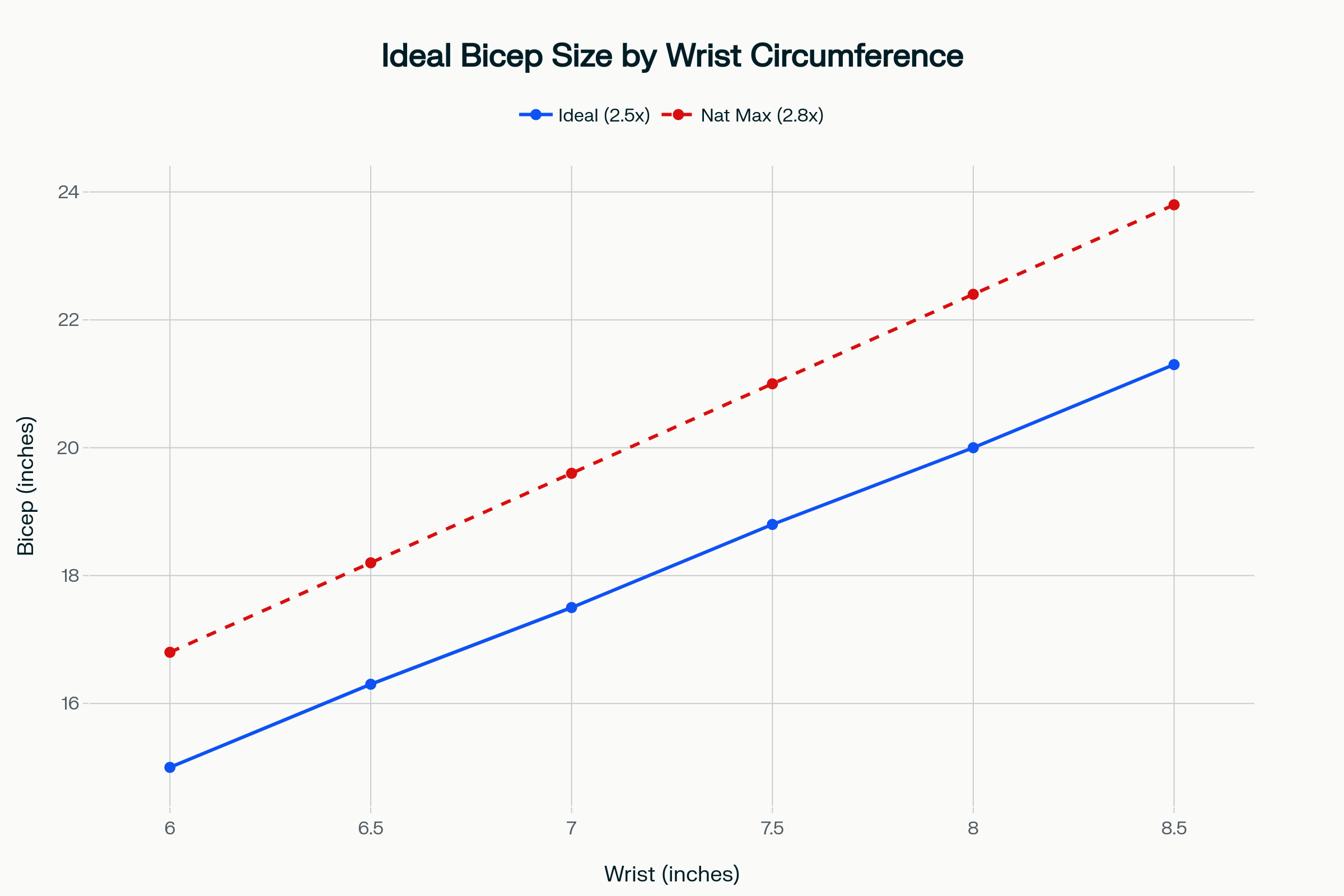
Visual guide showing the relationship between wrist circumference and ideal bicep size
Bicep Calculation: 7 × 2.5 = 17.5 inches (44.5 cm)
Forearm Calculation: 17.5 × 0.806 = 14.1 inches (35.8 cm)
Result: Ideal bicep = 17.5″, ideal forearm = 14.1″
Bicep Calculation: 70.9 × 0.20 = 14.2 inches (36 cm)
Forearm Calculation: 14.2 × 0.806 = 11.4 inches (29 cm)
Result: Ideal bicep = 14.2 inches, ideal forearm = 11.4 inches
Method 2 Result: 14.2 inches (36 cm)
Average: (17.5 + 14.2) / 2 = 15.9 inches (40.3 cm)
Body Type Adjustment (Mesomorph): 15.9 × 1.0 = 15.9 inches (40.3 cm)
Goal Adjustment (Aesthetics): 15.9 × 1.0 = 15.9 inches (40.3 cm)
Final Ideal Bicep: 15.9 inches (40.3 cm)
Final Ideal Forearm: 15.9 × 0.806 = 12.8 inches (32.5 cm)
Maximum Calculation: 7 × 2.8 = 19.6 inches (49.8 cm)
Result: Maximum natural potential = 19.6 inches
Note: This represents peak genetic potential after years of optimal training and may not be achievable by all individuals.
Body Types and Arm Development
| Body Type | Characteristics | Arm Potential | Training Approach |
|---|---|---|---|
| Ectomorph | Lean, narrow frame, small wrists, fast metabolism | Lower (×0.94) | Higher volume (15-20 sets/week), calorie surplus essential, focus on compound movements |
| Mesomorph | Athletic, medium frame, builds muscle easily | Standard (×1.0) | Balanced approach (12-16 sets/week), responds well to progressive overload |
| Endomorph | Stocky, thick wrists, stores fat easily | Higher (×1.06) | Moderate volume (12-15 sets/week), focus on body composition and definition |
How to Measure Arms Correctly
Bicep Measurement Technique
Step 1: Stand with arm at 90° angle (elbow bent)
Step 2: Flex bicep as hard as possible
Step 3: Wrap tape measure around peak of bicep (thickest point)
Step 4: Keep tape snug but not tight, parallel to floor
Step 5: Record measurement at peak flex
Step 6: Measure both arms and use the larger measurement
Use our Workout Warm-Up Calculator before measuring to ensure muscles are properly activated for accurate results.
Forearm Measurement Technique
Step 1: Extend arm fully or bend slightly
Step 2: Make a tight fist or flex forearm
Step 3: Measure at widest point (typically 2-3 inches below elbow)
Step 4: Keep tape level and snug
Step 5: Record measurement at peak flex
Common Mistakes to Avoid:
• Measuring bicep relaxed (underestimates size)
• Tape not at peak of bicep muscle
• Pulling tape too tight (false reading)
• Inconsistent measurement location
Average Arm Sizes (Reference Data)
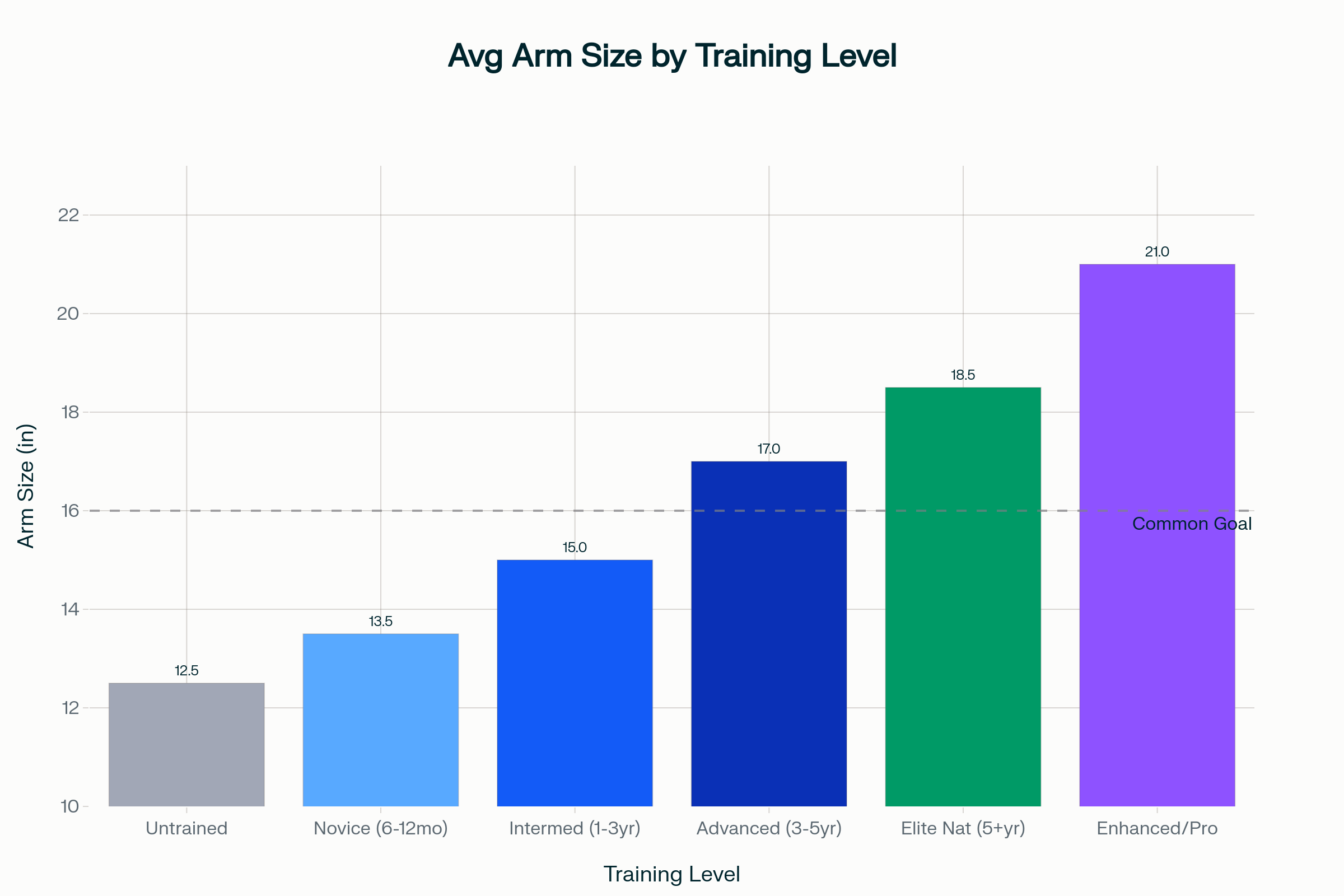
Visual representation of average arm sizes across different training experience levels
| Training Level | Average Arm Size | Description |
|---|---|---|
| Untrained Men | 12-13 inches (30-33 cm) |
Average adult male with no resistance training |
| Novice (6-12 months) | 13-14 inches (33-36 cm) |
Consistent training, basic muscle development |
| Intermediate (1-3 years) | 14-16 inches (36-40 cm) |
Solid training foundation, noticeable development |
| Advanced (3-5 years) | 16-18 inches (40-45 cm) |
Significant muscle mass, approaching genetic limits |
| Elite Natural (5+ years) | 18-19 inches (45-48 cm) |
Near genetic maximum, rare achievement naturally |
| Enhanced/Pro | 20+ inches (50+ cm) |
Beyond natural limits, requires performance enhancement |
Frequently Asked Questions
What’s the average arm size for men?
Average arm circumference for adult men varies by population but typically ranges from 30-33 cm (12-13 inches) for untrained individuals. However, “average” doesn’t equal “ideal” – your ideal arm size depends on YOUR bone structure (wrist size), height, and body type. Someone with a 6.5-inch wrist will have a different ideal than someone with a 7.5-inch wrist despite both being male.
How long does it take to build 16-inch arms naturally?
For most natural lifters starting from average (12-13 inches), building 16-inch arms takes 2-4 years of consistent training and proper nutrition. First-year gains are fastest (1-2 inches possible), then progress slows. Genetics play a major role—those with favorable bone structure (larger wrists) reach 16 inches faster. If 16 inches exceeds your natural potential (wrist × 2.5), it may not be achievable naturally.
Should forearms be as big as biceps?
No, forearms should NOT be as large as biceps. The golden ratio for aesthetic proportions dictates that forearms should be approximately 80.6% of bicep size (ratio of 0.806). For example, if your biceps are 40 cm (15.7″), ideal forearms are 32.2 cm (12.7″). Forearms larger than biceps create disproportionate appearance, while significantly smaller forearms look underdeveloped and weak.
Do I need direct arm training or are compound lifts enough?
While compound lifts (rows, pull-ups, presses) provide significant arm stimulus, direct arm training is essential for optimal development. Biceps respond well to isolation work because compound movements don’t fully exhaust them. Forearms especially require direct training—compound lifts rarely develop forearms fully. For best results, combine 2-3 compound lifts per week with 12-20 sets of direct arm work weekly.
What’s the biggest natural arm size possible?
Maximum natural arm size is approximately wrist circumference × 2.8. For a 7-inch (17.8 cm) wrist, this means roughly 19.6 inches (49.8 cm) at peak development. However, very few natural lifters reach this ceiling—it requires exceptional genetics, 5-10+ years of optimal training, perfect nutrition, and favorable hormonal profile. Most natural lifters plateau at wrist × 2.3-2.5. Arms exceeding 20 inches typically indicate performance enhancement use.
⚕️ Medical Disclaimer
This ideal arm size calculator provides estimates based on mathematical formulas and anthropometric research for educational purposes only. Results do not constitute medical advice, diagnosis, or treatment. Individual arm development potential varies based on genetics, bone structure, training history, age, hormones, and overall health. The calculated “ideal” represents aesthetic targets from bodybuilding tradition and may not be achievable, appropriate, or desirable for all individuals. Consult with healthcare professionals, certified personal trainers, or sports nutritionists before starting any new exercise or nutrition program, especially if you have pre-existing conditions affecting joints, tendons, or cardiovascular health. Prioritize sustainable, natural muscle development over unrealistic targets.
