
🏋️ Barbell Plate Calculator
Instantly see which weight plates you need to load on your barbell. Get a visual guide that makes setting up your lifts quick and easy.
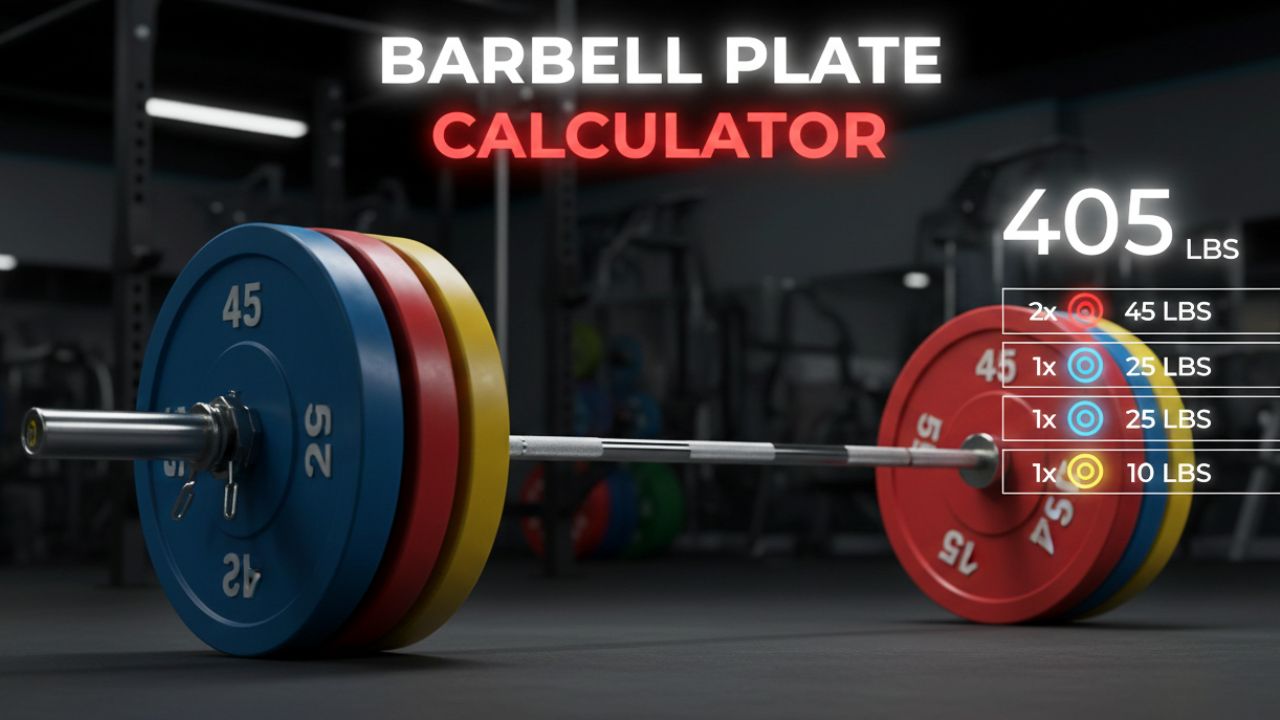
How to Load Weight Plates on a Barbell
Loading weight plates correctly is a fundamental skill for anyone lifting weights. Whether you’re doing squats, deadlifts, or bench press, knowing which plates to use saves time and prevents errors that could affect your workout.
The basic concept is simple: your barbell has a fixed weight, and you add plates to both sides equally until you reach your target weight. The math is straightforward, but it gets tricky when you’re working with multiple plate sizes.
Plates needed per side = (225 – 45) ÷ 2 = 90 lbs
Load each side with: One 45 lb plate + One 35 lb plate + One 10 lb plate
Total: 45 + 90 + 90 = 225 lbs ✓
Common Barbell Weights
Different barbells have different weights. Using the wrong bar weight in your calculations means you’ll load the wrong amount. Here are the most common barbell types you’ll find in gyms:
Standard Olympic Barbell (Men’s)
Weight: 45 lbs (20 kg)
Length: 7.2 feet (2.2 meters)
Use: Most common bar for squats, deadlifts, bench press, rows
Women’s Olympic Barbell
Weight: 35 lbs (15 kg)
Length: 6.6 feet (2 meters)
Diameter: Thinner grip (25mm vs 28-29mm)
Use: Smaller diameter makes it easier to grip for those with smaller hands
Training or Technique Bar
Weight: 15-25 lbs (7-11 kg)
Use: Learning proper form, rehabilitation, or when standard bars are too heavy
According to research published in the Journal of Strength and Conditioning Research, using appropriate equipment weight is essential for progressive training and preventing injury, particularly for beginners developing proper lifting mechanics.
Standard Weight Plate Sizes
Weight plates come in standard sizes with specific colors that are consistent across most gyms. Learning these colors helps you load quickly without reading every plate.
Pounds (LBS) – Standard in USA
- 45 lbs (Blue): Most common heavy plate
- 35 lbs (Yellow): Mid-weight plate
- 25 lbs (Green): Standard mid-weight
- 10 lbs (Gray/White): Common lighter plate
- 5 lbs (Purple/Blue): Small increment plate
- 2.5 lbs (Pink/Small): Micro-loading plate
Kilograms (KG) – International Standard
- 25 kg (Red): Heaviest standard plate
- 20 kg (Blue): Very common heavy plate
- 15 kg (Yellow): Mid-weight plate
- 10 kg (Green): Standard mid-weight
- 5 kg (White): Common lighter plate
- 2.5 kg (Small Blue): Small increment
- 1.25 kg (Small Red): Micro-loading
Studies on progressive overload show that using smaller increment plates (2.5 lbs or 1.25 kg) is crucial for continued strength gains, especially for upper body lifts where smaller jumps prevent stalling. You can also use our Workout Intensity Calculator to track how these small increases affect your overall training effort.
Quick Loading Combinations
Memorizing common loading combinations speeds up your gym sessions. Here are the most frequently used setups with a standard 45 lb Olympic bar:
Popular LBS Combinations
- 135 lbs: One 45 lb plate per side (45 + 45 + 45 = 135)
- 185 lbs: One 45 lb + One 25 lb per side
- 225 lbs: Two 45 lb plates per side
- 275 lbs: Two 45 lb + One 25 lb per side
- 315 lbs: Three 45 lb plates per side
- 405 lbs: Four 45 lb plates per side
Popular KG Combinations (20 kg bar)
- 60 kg: One 20 kg plate per side
- 100 kg: Two 20 kg plates per side
- 140 kg: Three 20 kg plates per side
- 180 kg: Four 20 kg plates per side
According to NSCA guidelines, progressing in weight systematically (typically 2.5-10 lb or 1.25-5 kg increments depending on the lift and training level) is key for continued strength development.
