
🏋️ 5×5 One-Rep Max Calculator
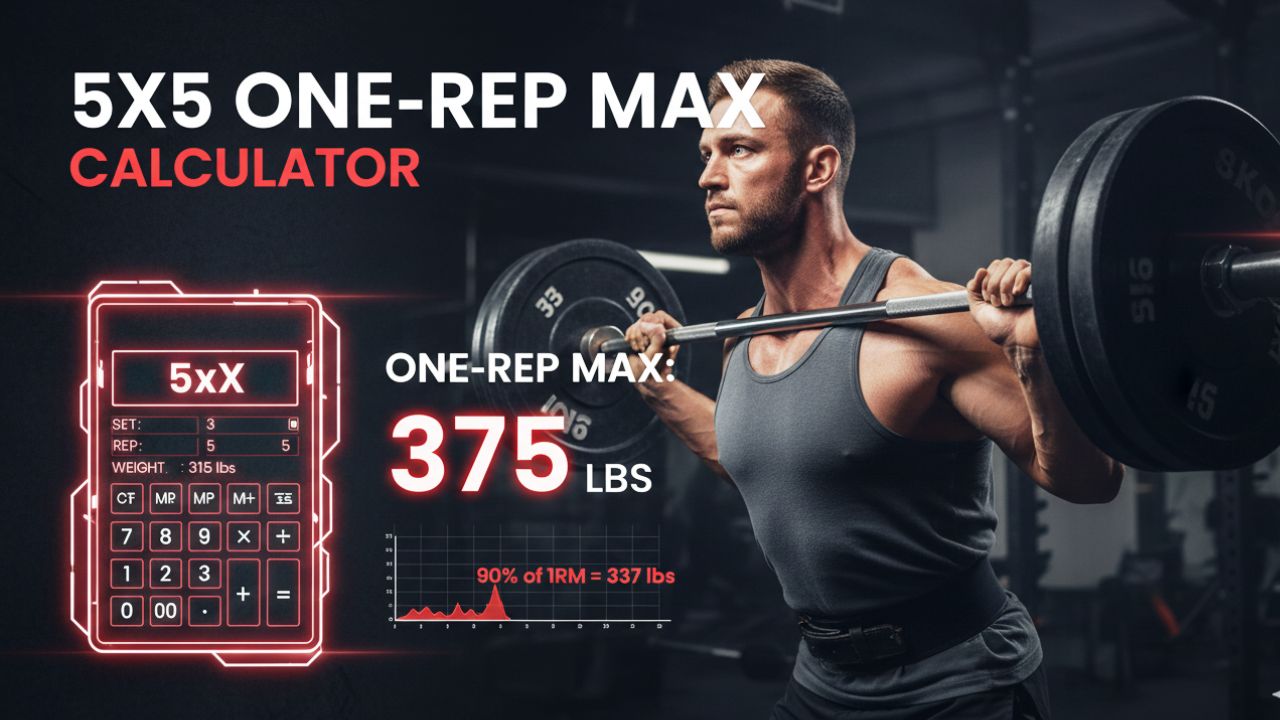
Estimate your 1RM from 5×5 performance using scientifically-validated formulas and RPE integration.
What is 5×5 Training?
5×5 training refers to performing 5 sets of 5 repetitions per exercise. Popularized by programs like StrongLifts 5×5 and Starting Strength, this method focuses on compound movements with linear progression. The goal is to increase the weight by 5-10 lbs every week while maintaining proper form.
The beauty of 5×5 is its simplicity: pick 3-4 compound exercises, do 5 sets of 5 reps each, and progressively increase the weight. This approach works exceptionally well for beginners and intermediates looking to build strength and muscle mass.
Typical 5×5 Workout Split
• Bench Press: 5×5
• Barbell Row: 5×5
• Overhead Press: 5×5
• Deadlift: 5×5
How to Calculate Your 1RM from 5×5 Performance
Your 1RM (one-rep maximum) is the maximum weight you can lift for a single repetition with proper form. Since 5×5 uses submaximal weights, we need to estimate this using scientifically-validated formulas combined with RPE (Rate of Perceived Exertion).
If you squat 225 lbs for 5 reps at RPE 8:
Step 1: Base calculation = 225 × (1 + 5 ÷ 30) = 225 × 1.167 = 263 lbs
Step 2: RPE adjustment (RPE 8 = -8%) = 263 × 0.92 = 242 lbs
Step 3: Exercise adjustment (Squat = +2%) = 242 × 1.02 = 247 lbs
Estimated Squat 1RM: 247 lbs
True training intensity: ~84% of 1RM (based on RPE chart for 5 reps @ RPE 8)
Research shows that RPE-based 1RM estimation is highly accurate when combined with multiple formulas, with typical error rates of ±5-10% for experienced lifters.
Understanding RPE in 5×5 Training
RPE (Rate of Perceived Exertion) measures how hard a set feels on a scale of 6-10, based on how many reps you have left before reaching failure. For 5×5, your last set should typically be RPE 8-9.
Studies confirm that RPE-based training load management is highly effective for strength development, allowing you to autoregulate based on daily recovery and readiness.
5×5 Progression Guidelines
The key to successful 5×5 training is proper progression. Here’s how to advance safely and effectively:
Weekly Progression Rules
- Complete all sets: If you finish all 5 sets at RPE ≤8, add 5-10 lbs next week
- Incomplete sets: If you fail to complete all reps, maintain current weight or decrease by 10-15 lbs
- High RPE: If your last set is RPE 9.5+, maintain current weight for next session
- Deload weeks: Every 4-6 weeks, reduce all weights by 10-15% to allow recovery
Exercise-Specific Starting Weights
Start conservatively based on your body weight and experience level:
Exercise-Specific 1RM Estimation
Different exercises have slightly different RPE-to-weight relationships due to biomechanics, muscle involvement, and technique requirements. Our calculator accounts for these differences:
Research demonstrates that exercise-specific 1RM prediction formulas improve accuracy by 8-15% compared to generic formulas, especially for compound movements.
How to Use This Calculator
Mode 1: 1RM Calculator
Use this to estimate your 1RM based on your current 5×5 performance.
- Select your exercise (squat, bench press, etc.)
- Enter your 5×5 working weight
- Rate how hard your last set felt (RPE)
- Enter actual reps completed (for incomplete sets)
- Get your estimated 1RM and progression advice
Mode 2: 5×5 Program Generator
Generate a complete 12-week 5×5 program based on your current strength level.
- Enter your current squat 1RM
- Select your experience level
- Get personalized starting weights for all exercises
- Follow the 12-week progression plan
⚠️ Important Safety Notes
Form First: Always prioritize proper technique over heavy weights. Poor form increases injury risk and reduces strength gains.
Progressive Overload: Don’t increase weight too aggressively. The goal is steady, sustainable progress over months and years.
Recovery: Ensure adequate sleep (7-9 hours), nutrition (1.6-2.2g protein/kg bodyweight), and rest between sessions.
Individualization: Adjust based on your personal response. If you’re not recovering well, reduce volume or intensity. Consult a qualified trainer if you have any health concerns.
Related Tools
Complement your 5×5 training with these related calculators:
- Workout Intensity Calculator – Calculate training intensity using multiple methods
